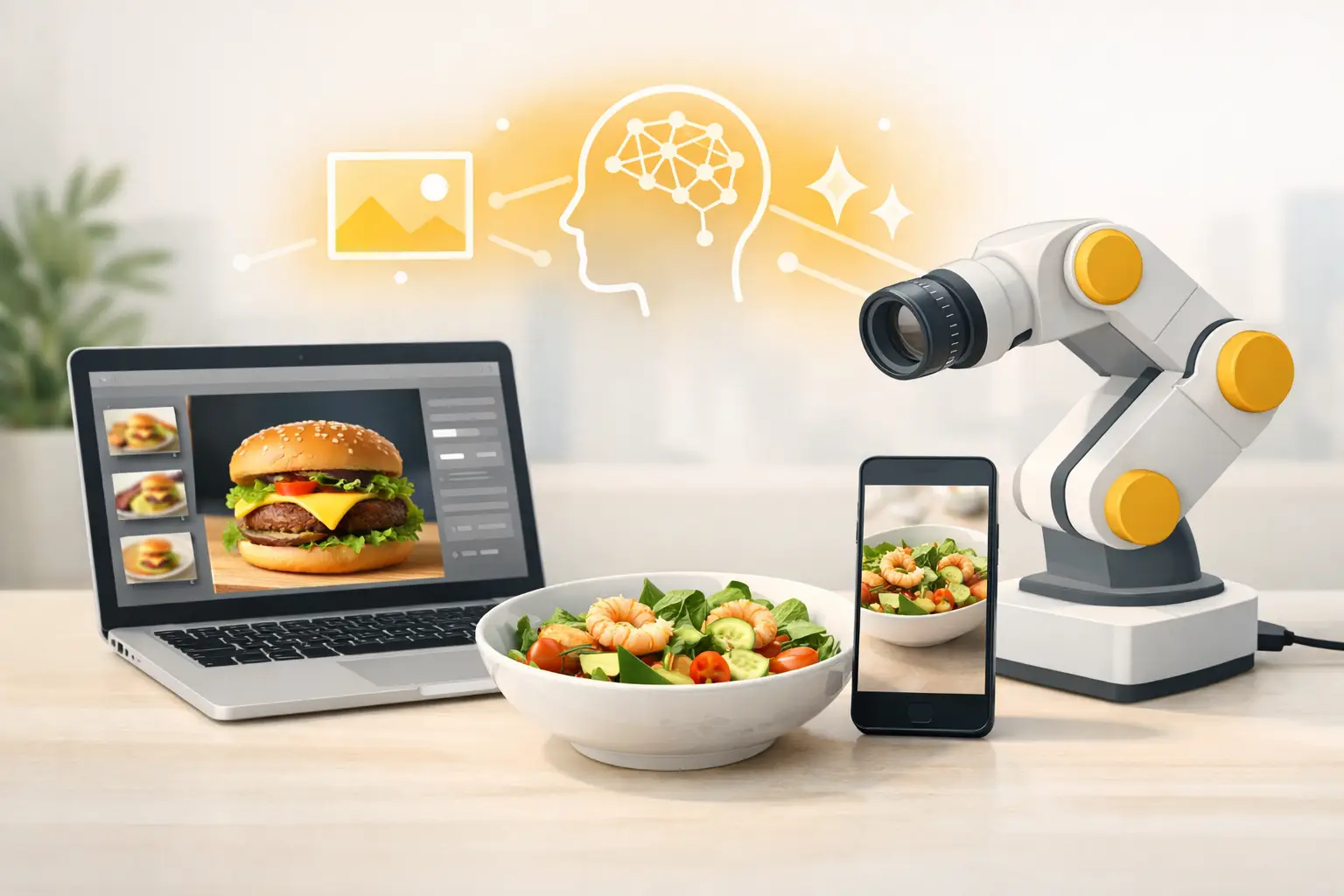
When a promo needs to go live by Friday, waiting on a food shoot is rarely the best option. AI food pictures give restaurants, food brands, and marketing teams a faster way to produce polished visuals for ads, menus, product pages, and social content without booking a studio, sourcing props, or coordinating reshoots.
That speed is the obvious benefit, but it is not the only one. The bigger shift is operational. Food content has always been expensive to produce consistently. You need fresh ingredients, a stylist, a photographer, a location, lighting, and time. Then you need to repeat that process every time a seasonal offer changes, packaging updates, or a channel needs a different crop. For teams under pressure to publish more often, that model breaks down quickly.
Why AI food pictures are gaining traction
Most businesses do not need one perfect hero shot every quarter. They need volume. A restaurant group may need new menu assets, paid social variants, delivery app images, and local store promotions in the same week. A CPG brand may need launch visuals, retailer-ready images, display ad creative, and short-form content concepts at the same time.
AI food pictures fit that reality because they reduce setup time and increase output. Instead of treating every visual request like a production event, teams can generate multiple on-brand options in a shorter cycle. That changes how creative work gets scheduled. Marketing moves faster, testing becomes easier, and the cost of producing alternate versions drops.
This matters most for businesses with recurring content demand. If you only need a few premium campaign images per year, traditional photography still makes sense in some cases. If you need a steady stream of usable visuals across channels, AI becomes much more practical.
Where AI food pictures work best
The strongest use case is day-to-day commercial content. That includes menu boards, web banners, email campaigns, social posts, product mockups, and paid ad creative. In those environments, speed and consistency usually matter more than the behind-the-scenes story of how the image was made.
Food businesses also benefit because the visual requirements are repetitive but not identical. A burger brand may need the same item shown as a square social crop, a vertical story asset, a clean menu image, and a dramatic promotional shot. With AI workflows, the team can generate variations around the same concept instead of restarting from scratch each time.
There is also a clear advantage for early-stage brands and independent operators. A local bakery or ghost kitchen may not have the budget for frequent shoots, but it still needs professional-looking content to compete. AI narrows that gap by making high-volume visual production more accessible.
The trade-off: general AI vs food-specific tools
Not all image generators handle food well. General-purpose AI tools can produce attractive outputs, but food is a demanding category. Texture, gloss, steam, garnishes, layers, sauces, and portion realism all affect whether an image feels appetizing or obviously synthetic.
This is where specialization matters. A food-focused platform is built around the visual logic of food marketing, not just image generation in general. That usually means better starting quality, more commercially usable outputs, and less time spent fighting prompts to get basic details right.
For a marketer or business owner, that difference is practical, not theoretical. If your team has to generate twenty ad-ready options this week, the best tool is not the one with the broadest feature list. It is the one that gets food visuals right faster.
What commercial teams actually need from AI food pictures
A good result is not just a pretty image. It needs to fit the job. Commercial content teams usually care about four things at once: visual quality, brand consistency, output speed, and cost control.
Visual quality is the baseline. If the cheese looks plastic or the produce looks structurally wrong, the image will not hold up in a campaign. Brand consistency is just as important. A business that posts bright, minimal product shots one day and moody editorial-style images the next creates unnecessary friction across channels.
Output speed matters because content demand is continuous. Teams need to move from idea to asset quickly, especially when running promotions or testing creative. Cost control matters because image generation at scale only works if usage stays predictable enough to manage.
That is why a credit-based SaaS model makes sense for many food businesses. It gives teams a clearer framework for volume, budgeting, and plan selection. Light users can stay efficient on a smaller allocation. Heavier users can scale output through higher-tier subscriptions or added capacity when campaign demand spikes.
How to evaluate an AI food pictures platform
The first question is simple: can it create food images that look usable without excessive prompt work? If the answer is no, the rest of the workflow does not matter much.
The second question is whether the platform supports production, not just experimentation. Marketers and creative teams need repeatable outputs. They need to create assets in batches, adapt compositions, and generate visuals that fit real placements. A platform that is fun for one-off image creation may still fall short for campaign production.
The third question is whether it supports multiple content types. Static images are often the starting point, but many teams also need motion assets. If the same system can support both image and video creation, the workflow becomes more efficient.
The last question is commercial fit. Some users need occasional menu visuals. Others need ongoing asset pipelines across multiple brands or locations. Plan structure matters here. Starter usage, pro-level output, and business-scale production are different operating modes, and the platform should reflect that clearly.
AI food pictures and brand control
One concern comes up often: if AI makes content easier to produce, does everything start to look generic? It can, if the workflow is weak.
The fix is not avoiding AI. The fix is building a tighter system around it. Teams should define visual direction up front, use consistent composition logic, and generate with channel-specific intent. That keeps output aligned with the brand rather than chasing novelty.
This is another reason niche tools tend to outperform broad ones in food marketing. A platform designed for food visuals can support more deliberate workflows around plating, framing, product emphasis, and commercial presentation. That makes it easier to produce images that look intentional instead of random.
For brands with recurring campaigns, the real advantage is not only faster creation. It is more controlled creation at scale.
When AI food pictures are the better choice
If you need original behind-the-scenes restaurant photography, staff portraits, or documentary-style brand storytelling, AI is not the full answer. Real-world shoots still have a place. They capture specific people, places, and moments that synthetic visuals cannot replace.
But if the job is to create appetizing food imagery for performance marketing, menu systems, launch creative, or routine content production, AI is often the more efficient option. It removes the scheduling overhead, reduces production costs, and makes testing multiple concepts much easier.
For many businesses, the smartest model is hybrid. Use traditional photography where authenticity to a real location or product moment matters most. Use AI for scale, speed, and variation everywhere else.
The operational advantage most teams care about
The real value of AI food pictures is not novelty. It is throughput. Content teams are under constant pressure to produce more versions, more formats, and more campaigns with tighter timelines. A workflow that can generate high-quality food visuals quickly has a direct impact on launch speed and creative capacity.
That is especially true for brands managing multiple products, offers, or storefronts. Once content demand becomes ongoing, production efficiency becomes a competitive advantage. Teams that can create more polished assets in less time can test faster, publish more consistently, and support more channels without scaling production costs at the same rate.
Platforms built specifically for food make that advantage more attainable because they reduce the gap between concept and usable output. Umami AI fits that model by focusing on food-first image and video creation for commercial teams that need production value without the usual production drag.
The best way to think about AI food pictures is simple: not as a replacement for every camera, but as a faster system for the visual work that keeps food brands moving. If your team needs more content than your current process can realistically support, that is usually the moment to change the workflow, not just the schedule.