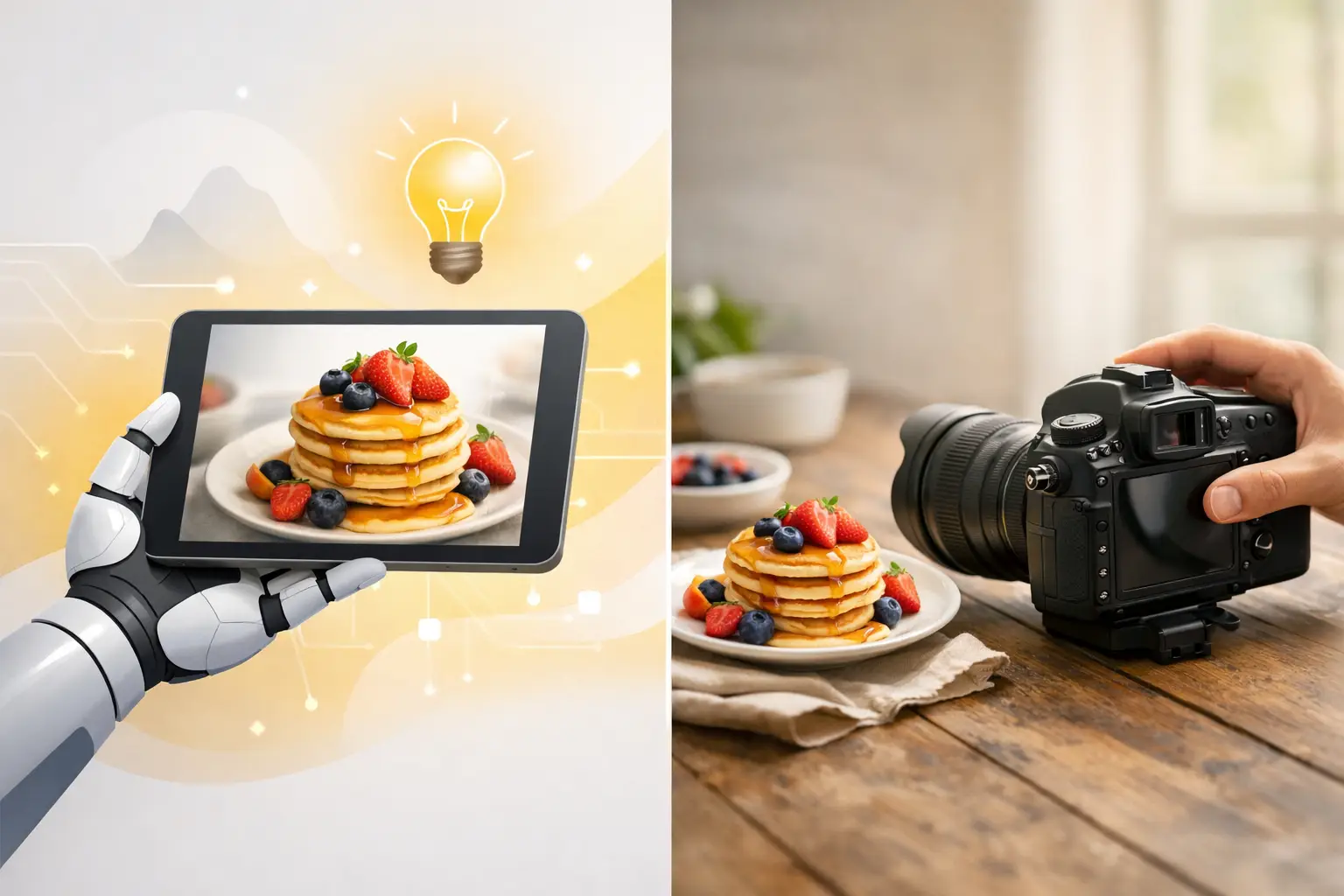
A seasonal menu launch used to mean booking a photographer, sourcing props, coordinating dishes, and hoping every shot made the cut. Now the decision often starts earlier: ai visuals vs food photography. For food brands and operators under pressure to publish faster, test more creative, and control production costs, this is no longer a creative debate alone. It is an operations decision.
AI visuals vs food photography: what actually changes
The biggest difference is not just how the image is made. It is how the whole workflow behaves.
Traditional food photography is production-heavy. You schedule a shoot, prepare the food, style the scene, capture multiple setups, review selects, and move into retouching. That process can produce premium assets, especially when texture accuracy, packaging fidelity, and real-world lighting matter. But it is slower, more expensive, and less flexible once the shoot ends.
AI visuals shift the work upstream. Instead of organizing a set, you define the scene through prompts, composition choices, style direction, and iteration. That means faster output, lower marginal cost per asset, and more freedom to generate variations for different channels. If a campaign needs five visual directions before lunch, AI fits that requirement better than a reshoot.
For businesses producing content every week, that workflow difference is often the deciding factor.
Where food photography still wins
Food photography remains the stronger choice when accuracy is the product.
If you are selling packaged foods, beverages, or plated dishes that customers will receive exactly as shown, photography gives you the most reliable match between image and reality. That matters for ecommerce product pages, national packaging campaigns, franchise brand standards, and any use case where legal review or customer trust depends on precision.
Photography also performs well when a brand needs a hero asset with high production value. A signature homepage image, a launch campaign for a major retail push, or investor-facing brand materials may justify a full shoot because the asset needs a level of specificity that goes beyond visual appeal.
There is also a texture question. AI can create glossy, appetizing surfaces and dramatic steam, but close inspection still matters. Sauces, crumb structure, melting cheese, carbonation, and ingredient behavior can look convincing without being truly accurate. For some campaigns, convincing is enough. For others, especially product-led marketing, it is not.
Where AI visuals pull ahead
If the goal is content volume, AI usually wins by a wide margin.
Restaurants, ghost kitchens, beverage brands, agencies, and social teams rarely need one perfect image. They need dozens of usable assets across promos, menu boards, paid social, delivery apps, web banners, and seasonal offers. In that environment, AI is less about replacing the photographer and more about removing bottlenecks.
A shoot has hard limits. Budget, timing, staff availability, perishability, and post-production all reduce how much content you can realistically produce. AI visuals remove most of those constraints. You can test a moody late-night burger scene, then switch to a bright lunch setup, then generate cropped variations for story ads and menu placements without rebuilding a set.
That makes AI especially effective for iterative marketing. If one promotion underperforms, you can generate alternatives fast. If a social manager needs three visual directions for Friday's post, that is a workflow task, not a production event.
For many commercial teams, speed is not a convenience. It is the requirement.
Cost is not just the invoice
On paper, food photography often looks more expensive because it includes obvious line items: photographer, stylist, studio, ingredients, props, editing, and coordination time. AI visuals usually look cheaper because the workflow runs through a subscription or usage-based credit model.
But the more useful comparison is cost per approved asset.
A traditional shoot can be efficient if you need a small number of high-value images and have clear creative direction. In that case, the upfront cost may be worth it. The problem appears when the business needs ongoing content. Every new promotion, menu item, holiday campaign, or channel variation can trigger another round of production.
AI lowers the cost of experimentation. You can create ten concepts, reject eight, and still stay within a practical production budget. That changes how teams work. They approve faster, test more often, and avoid holding up campaigns because a shoot cannot be organized in time.
This is where a specialized platform matters. General-purpose image tools can generate food, but they often require more prompt work, more retries, and more cleanup. A food-specific system is built to reduce wasted generations and improve commercial usability, which helps the economics hold up at scale.
Brand consistency is a real dividing line
Consistency is one of the most overlooked parts of ai visuals vs food photography.
Photography gives you consistency when the same team, lighting setup, styling approach, and retouching standards are maintained over time. That can work well for established brands with repeatable production systems. But consistency becomes harder when different shoots happen months apart, with changing teams, locations, or budgets.
AI can make consistency easier if the platform supports controlled composition, style direction, and repeatable outputs. Instead of rebuilding the visual language from scratch for every campaign, teams can generate assets within a narrower system. That is useful for multi-location restaurants, ecommerce catalogs, and agencies managing multiple food clients with distinct visual identities.
The catch is that AI consistency depends on the workflow being disciplined. If every user writes prompts differently and no one standardizes visual rules, results drift. The tool can move fast, but the team still needs a framework.
The trust question
Customers do not buy the image. They buy the food behind it.
That is why the best choice depends on how closely the visual needs to represent the final product. If your ad shows a sandwich that will be delivered in a branded wrapper with fixed ingredients, representation matters. If your campaign is promoting a flavor profile, a category, or an offer and the visual is serving as marketing creative rather than literal product documentation, AI becomes much more viable.
This does not mean one method is honest and the other is not. Both involve styling, editing, and creative direction. It means the acceptable distance between the visual and the delivered item changes by channel and use case.
A homepage hero, social campaign, poster, or concept mockup gives you more room. A product detail page or regulated packaging launch gives you less.
The strongest teams use both
For most commercial food brands, this is not a winner-take-all choice.
Photography still makes sense for flagship assets, packaging-accurate imagery, and campaigns where legal, retail, or product standards require realism tied to the actual item. AI visuals make more sense for campaign expansion, daily social content, promotional variants, menu creativity, concept testing, and short-form visual volume.
That hybrid model is practical. Use photography where precision carries the business case. Use AI where speed, iteration, and output scale matter more. This is often the most efficient way to keep content quality high without treating every asset like a studio production.
Specialized tools make that hybrid model easier to run. A platform like Umami AI is designed for food-first commercial workflows, which means the output is not just visually appealing. It is built for teams that need usable assets quickly, across channels, without the overhead of recurring shoots.
So which one should you choose?
Choose food photography when the image must closely match a real product, when the asset will carry heavy brand weight, or when compliance and trust leave little room for interpretation.
Choose AI visuals when you need speed, content volume, visual variation, and a more efficient production cycle for marketing use.
If your team is constantly waiting on shoots, stretching a limited creative budget, or recycling the same old images because new production is too slow, AI is probably the better operating model. If your business depends on literal product representation, photography still earns its place.
The useful question is not which format is better in general. It is which one helps your team publish the right asset, at the right quality, on the right timeline. When content demand keeps rising, the smartest workflow is usually the one that removes friction without compromising the job the image needs to do.