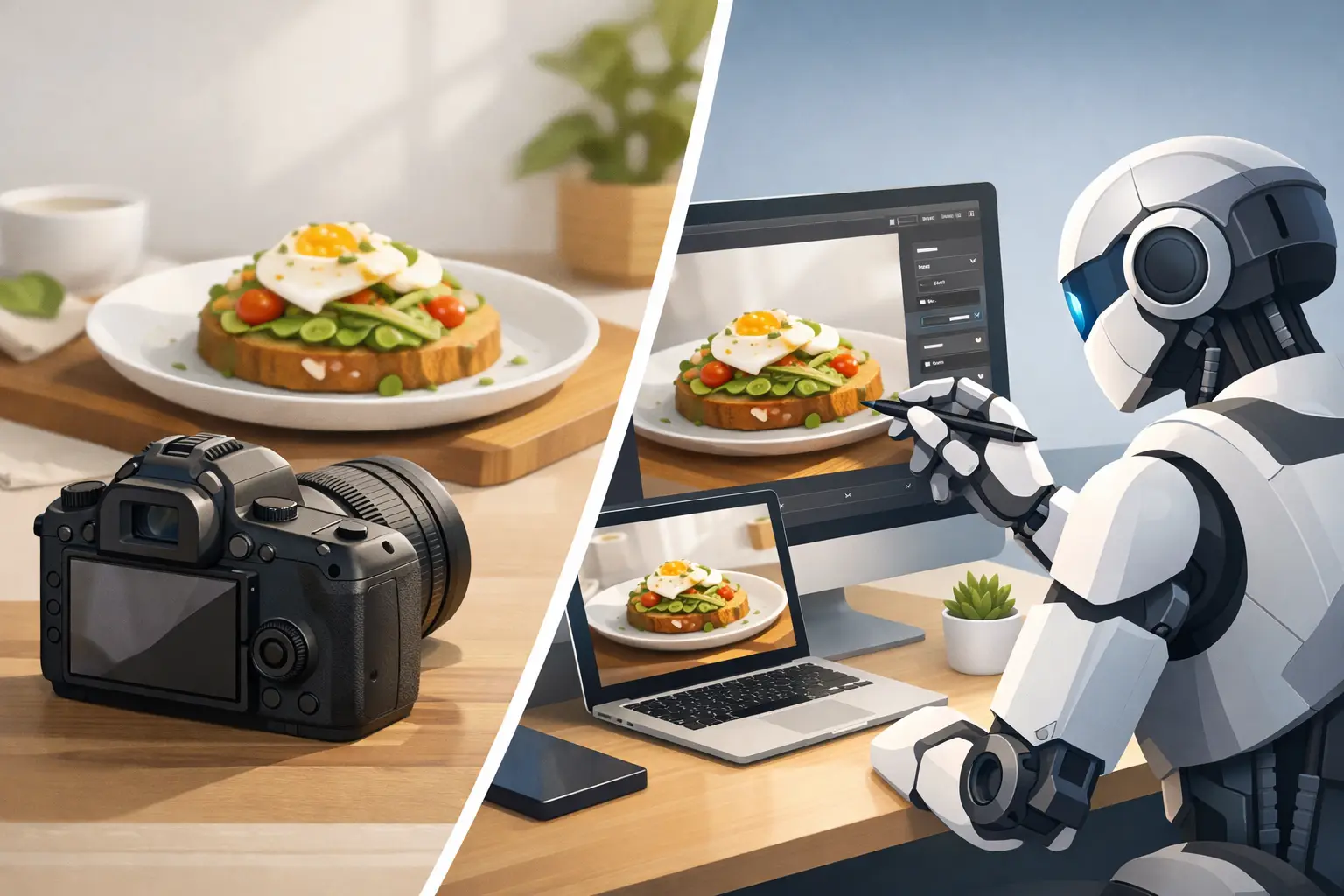
A restaurant needs six seasonal promo images by tomorrow. A frozen food brand needs 40 product variations for paid social next week. An agency needs consistent visuals for three menu launches without booking a studio, sourcing props, or coordinating a crew. That is where the question shifts from theory to operations: can AI replace food photography?
The short answer is yes, in some commercial workflows. But not in every case, and not for every standard. If your team cares about speed, output volume, cost control, and brand consistency across repeated campaigns, AI can replace a meaningful share of traditional food photography. If you need exact package accuracy, highly regulated product claims, or hero imagery tied to a real-world shoot with zero interpretation, photography still matters.
For most food businesses, the real decision is not AI or photography. It is which jobs should stay in a traditional production workflow, and which jobs should move to a faster, more scalable system.
Where AI can replace food photography
AI performs best when the goal is commercial content production at scale. That includes social creatives, menu banners, landing page visuals, email graphics, promotional concepts, seasonal updates, marketplace assets, and campaign testing. In those use cases, the value is straightforward: generate more visual options, faster, without the fixed cost and scheduling friction of a shoot.
Food photography is expensive because every image depends on logistics. You need the product, the styling, the lighting, the set, the timing, and often multiple rounds of revisions. Even a small shoot can turn into a multi-person production. That works when you are producing a flagship campaign or packaging image. It breaks down when the business needs fresh visuals every week.
AI changes that production model. Instead of rebuilding the process each time, teams can generate assets on demand, iterate quickly, and create multiple compositions from one concept. For a restaurant group, that might mean lunch promos, limited-time offers, delivery app graphics, and social posts without arranging repeated shoots. For a food brand, it can mean testing different backgrounds, plating styles, aspect ratios, and seasonal looks before spending budget on full production.
This is where a specialized platform has an advantage. General image tools can produce attractive results, but food content is its own category. Texture, steam, garnish placement, sauce behavior, crumb detail, glass reflections, and plating realism all matter. A food-specific system is better positioned to produce visuals that actually look usable in marketing, not just visually interesting.
Where AI still falls short
The strongest case against a full replacement is precision. If your image needs to show the exact product as sold, photography remains the safer option. That includes packaged foods with visible labels, items tied to strict brand standards, or products that need legal and merchandising accuracy.
A burger ad can look incredible in AI and still miss details that matter to a franchise operator. The bun shape may be slightly off. The cheese melt may look better than reality. The ratio of toppings may not reflect the actual item. For broad campaign visuals, that may be acceptable. For product-specific representation, it may not.
There is also a trust issue in some channels. Consumers expect a degree of polish in food marketing, but there is a line between aspirational and misleading. If the visual implies a product experience the business cannot deliver, the image may perform well upfront and create friction later.
So no, AI does not replace every form of food photography. It replaces the parts of the workflow where variation, speed, and visual volume matter more than documentary accuracy.
Can AI replace food photography for restaurants?
For restaurants, the answer is often yes, especially for promotional content. Most operators are not running photo shoots every time they launch a combo, a dessert special, or a holiday drink. They need assets fast, and they need them in the right format for Instagram, digital menus, in-store screens, and paid ads.
AI is a practical fit here because restaurant marketing is continuous. New offers appear every month. Local stores need variations. Social teams need frequent posts. Traditional production does not scale well for that rhythm.
What matters most to restaurant teams is not whether AI can perfectly mimic a high-end editorial shoot. It is whether it can produce appetizing, on-brand visuals quickly enough to support real campaign timelines. In many cases, it can.
That said, signature items still benefit from real photography when brand identity is tightly tied to a specific dish. If your hero product is the business, not just part of the menu, a true photo may still carry more value. But for the long tail of everyday creative needs, AI can cover a lot of ground.
Can AI replace food photography for brands and agencies?
Brands and agencies usually evaluate this question through a production lens. How many assets are needed, across how many channels, with how much variation, and on what timeline?
That is where AI becomes hard to ignore. A single campaign might need portrait and landscape formats, multiple backgrounds, alternate crops, seasonal variants, and concept directions for testing. With traditional photography, each new direction costs time and money. With AI, the team can move through options much faster and reserve live production for the assets that truly require it.
Agencies also benefit from speed during pitch and pre-production stages. Instead of waiting for mockups or building rough comps manually, teams can generate polished food visuals to sell a concept internally or to a client. That compresses cycle time and improves decision-making earlier in the process.
For packaged food brands, the best use case is often adjacent content rather than primary packaging imagery. Think lifestyle scenes, campaign backdrops, recipe visuals, serving suggestions, and promotional assets that support the product. Those are high-volume needs, and they do not always justify a full shoot.
The real trade-off: control versus scale
The reason this debate keeps coming up is simple. Food photography gives you physical control. AI gives you production scale.
With photography, you can art direct every ingredient, every prop, and every lighting decision in a real environment. With AI, you gain speed and volume, but you work through prompts, iterations, and generation logic rather than direct physical manipulation. That does not make AI weaker. It makes it better suited to different jobs.
For a business producing dozens of visuals every month, scale often matters more than handcrafted control on every single asset. The commercial question is not whether one method is more pure. It is whether the workflow supports the demand.
If your current process cannot keep up with campaign velocity, AI is not a novelty. It is an operational upgrade.
A better question than can AI replace food photography
The better question is: which visuals should still be photographed, and which should be generated?
That framing leads to better decisions. Keep traditional photography for flagship brand shoots, exact product representation, packaging, and cases where legal or customer expectation requires accuracy. Use AI for campaign variants, promotional concepts, social content, menu boards, ads, and rapid-turn creative production.
This hybrid model is already the practical answer for many teams. It protects quality where precision matters and removes bottlenecks where speed matters more.
It also improves budget allocation. Instead of spending heavily on repeated shoots for routine assets, businesses can focus photography budget on higher-value moments and use AI to handle the ongoing demand for fresh content.
So, can AI replace food photography?
Yes, for a large share of commercial food content, it already can. Not because it makes photography obsolete, but because it solves a different and increasingly common business problem: producing quality food visuals at speed, at scale, and without the overhead of traditional production.
The winners here will not be the teams arguing for one side. They will be the teams building a smarter visual pipeline. That means using photography where reality must be exact, and using specialized AI where speed, flexibility, and output volume drive better results. Platforms built specifically for food, including Umami AI, are part of that shift because they reduce the gap between generated content and commercially usable creative.
If your team is still treating every food visual like it needs a full shoot, the issue may not be quality. It may be workflow.