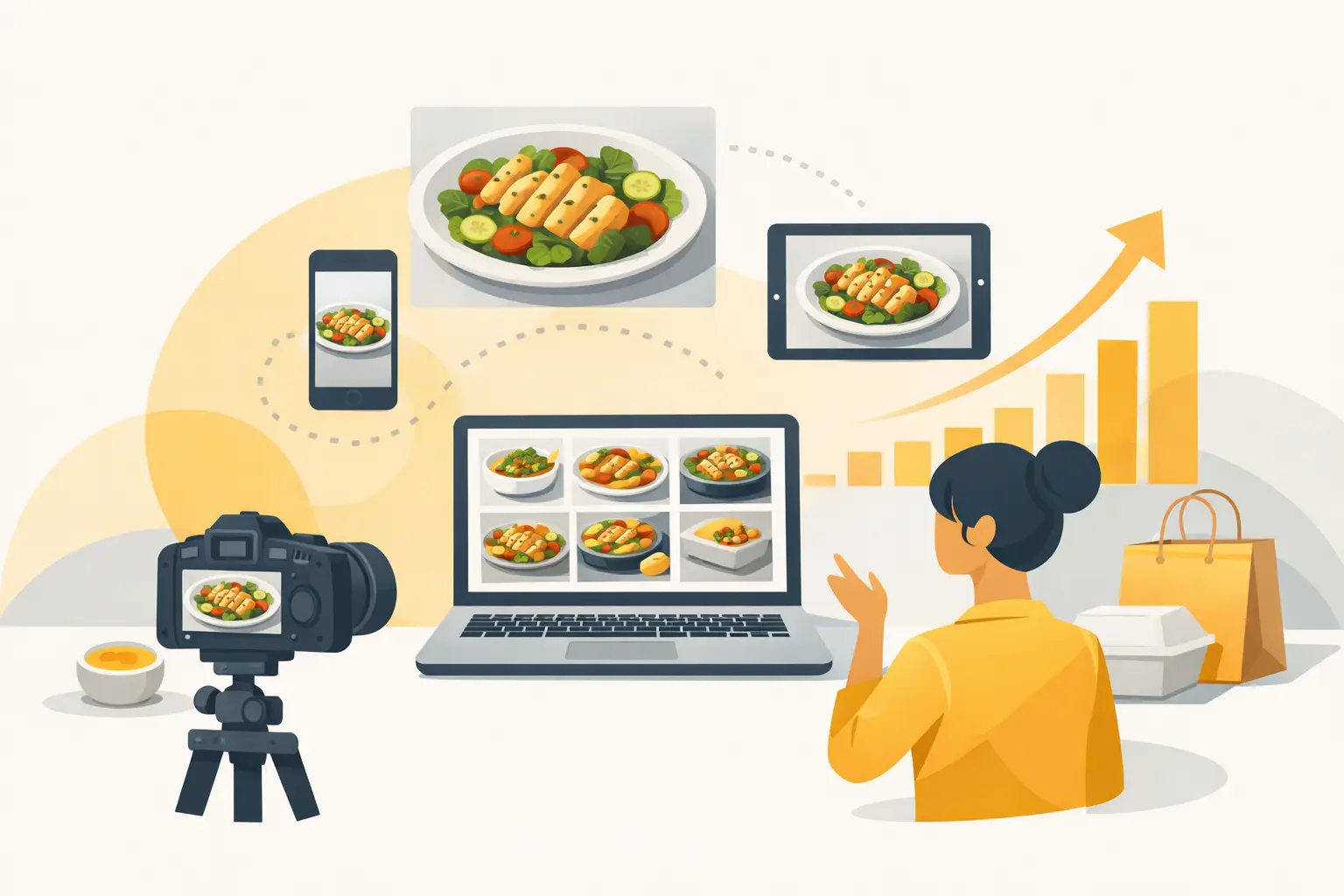
A single burger launch rarely needs a single image anymore. It needs a hero shot for the website, square crops for Instagram, vertical assets for stories and reels, menu graphics, paid social variants, and often short motion pieces to keep campaigns moving. That is the real pressure behind commercial food visuals - not just making food look good, but producing enough usable content, fast enough, to support actual revenue activity.
For restaurants, food brands, agencies, and ecommerce teams, the bottleneck is rarely taste or product quality. It is production. Traditional shoots are expensive, scheduling is slow, revisions create friction, and generic design tools often miss the details that make food marketing work. Commercial output demands a different standard: visuals that are appetizing, on-brand, repeatable, and ready to deploy across channels.
What commercial food visuals actually need to do
A commercial food visual is not the same as a nice food photo. It has a job. It must sell a dish, support a promotion, fit a channel, and match the brand system around it. If it looks attractive but does not align with campaign goals, it is decoration, not production.
That distinction matters because food businesses do not buy visuals in isolation. They need assets that slot into menus, ads, landing pages, marketplaces, packaging mockups, email headers, and short-form video. The image has to perform in context. A beautiful overhead pasta shot may work for editorial content, but if the goal is a delivery app thumbnail or a paid ad creative, composition, lighting, crop flexibility, and visual hierarchy all matter more.
This is why commercial food visuals tend to be judged by four practical standards: speed, consistency, adaptability, and output volume. Speed matters because campaigns move quickly. Consistency matters because the brand cannot look different every week. Adaptability matters because one concept often needs to become ten deliverables. Output volume matters because modern food marketing is content-hungry by default.
Why traditional production breaks under volume
A polished food shoot still has value. For flagship packaging, major launches, or category-defining campaign work, a custom production can make sense. But once a team needs recurring assets every week, the economics change.
Studio photography involves planning, props, food styling, retouching, scheduling, and approvals. Even when the final work is strong, the process is heavy. That makes it hard to test multiple offers, refresh seasonal items, localize promotions, or produce variations for different customer segments.
The problem gets worse for smaller operators and distributed brands. A restaurant group with multiple locations may need similar visuals for different menu items, regional promos, and platform formats. An emerging packaged food brand may need product-led creative before it can justify repeated shoot budgets. Agencies managing several food clients face another layer of complexity: they need throughput, not just craftsmanship.
Commercial food visuals at scale require a production model that can keep pace with demand. That is where older workflows start to fail. They were built for campaigns with longer timelines and fewer output requirements. Current channels reward frequency, testing, and fast creative iteration.
The shift toward AI-generated commercial food visuals
The appeal of AI in food marketing is not novelty. It is operational efficiency. Teams want a faster way to produce visuals that are usable in commercial settings without rebuilding the process from scratch for every asset.
That does not mean every AI image is automatically production-ready. General-purpose image tools can generate impressive outputs, but they often struggle with the details food marketers care about most: appetizing texture, believable ingredients, realistic plating, product framing, and consistency across a series. Food is a category where small visual errors stand out immediately. If the cheese pull looks artificial or the garnish is inconsistent between shots, the asset loses credibility.
This is why vertical specialization matters. A food-specific workflow is more useful than a broad creative tool when the requirement is commercial output rather than experimentation. Instead of treating food as one prompt category among many, a specialized platform can prioritize the composition logic, visual patterns, and asset needs that food businesses use every day.
For many teams, the practical benefit is simple. They can create more versions, explore more campaign directions, and generate channel-specific assets without waiting on another shoot cycle. That changes how marketing gets done. Creative production becomes more iterative and less constrained by calendar logistics.
Where commercial food visuals create the most value
The strongest use case is not replacing every photo ever taken. It is removing unnecessary friction from recurring visual production.
Restaurants can use commercial food visuals for menu refreshes, limited-time offers, social promotions, and third-party delivery listings. Food brands can build product hero images, campaign concepts, seasonal creative, and ecommerce support assets. Agencies can accelerate first-pass concepts, variant generation, and ongoing content packages for multiple clients.
There is also a clear advantage in format flexibility. One core concept can become a website banner, a portrait ad, a story format visual, and a short motion asset. That matters because channel fragmentation is now normal. Creative teams are not producing one finished image. They are producing systems of assets.
Short-form motion is another high-impact area. Static visuals still matter, but movement increases attention in paid social and organic placements. Even subtle animation, like steam rising from a dish or a slow camera push on a plated dessert, can expand the usefulness of a visual set without triggering the cost of a full video production.
What teams should evaluate before adopting a new workflow
Not every solution is a fit for every operation. The right choice depends on how often a team produces content, who approves it, and where it will be used.
If the need is occasional and highly bespoke, traditional production may still be the better route. If the need is ongoing, multi-format, and campaign-driven, a faster visual workflow becomes more compelling. The question is less about whether AI can generate an image and more about whether the system supports commercial reality.
That means evaluating output quality, of course, but also evaluating workflow design. Can non-technical users generate usable assets quickly? Can marketers produce enough variations for testing? Can creative teams keep a consistent visual standard across multiple campaigns? Is there a practical structure for scaling usage without restarting procurement every time demand increases?
This is where plan logic matters more than many buyers expect. A credit-based model can be efficient when it maps cleanly to actual production habits. Teams with lighter needs want predictable entry-level access. Heavier users need room for volume, along with options for expansion when campaign demand spikes. A platform built for commercial food visuals should make that scaling path straightforward rather than forcing users into a one-size-fits-all setup.
Commercial food visuals are now a throughput problem
Most food businesses already understand the value of strong visuals. The bigger issue is maintaining output without overstretching time, budget, or internal resources. That is why the market is moving away from one-off asset thinking and toward repeatable production systems.
A modern workflow should reduce production drag, not add another layer of creative complexity. It should help teams move from idea to usable asset quickly, preserve brand consistency, and support the channels that actually drive performance. For a restaurant operator, that may mean launching a promo this week instead of next month. For an agency, it may mean delivering more concepts without increasing overhead. For an ecommerce brand, it may mean keeping product pages and ad creatives fresh without waiting on studio availability.
Platforms like Umami AI fit this shift because they are designed around a narrower commercial use case. That focus matters. When a tool is built specifically for food images and video, the workflow is easier to align with real production needs: more assets, less setup, clearer plan tiers, and a faster route to campaign-ready output.
Why this category matters now
Food marketing has become more visually competitive at the same time that content demand has expanded. Customers see dishes before they buy them. They make decisions in scroll environments, marketplace grids, ad feeds, and mobile menus. If the visual does not land quickly, the offer gets ignored.
That creates pressure, but it also creates an advantage for teams that can produce faster. Commercial food visuals are no longer just a brand nice-to-have. They are operational infrastructure for growth. The teams that treat visual production as a scalable system, rather than an occasional creative event, will move faster on launches, test more aggressively, and stay more consistent across every place a customer encounters the brand.
The useful question is not whether you need more food content. You almost certainly do. The useful question is whether your current workflow can keep up with what your channels, campaigns, and customers already demand.