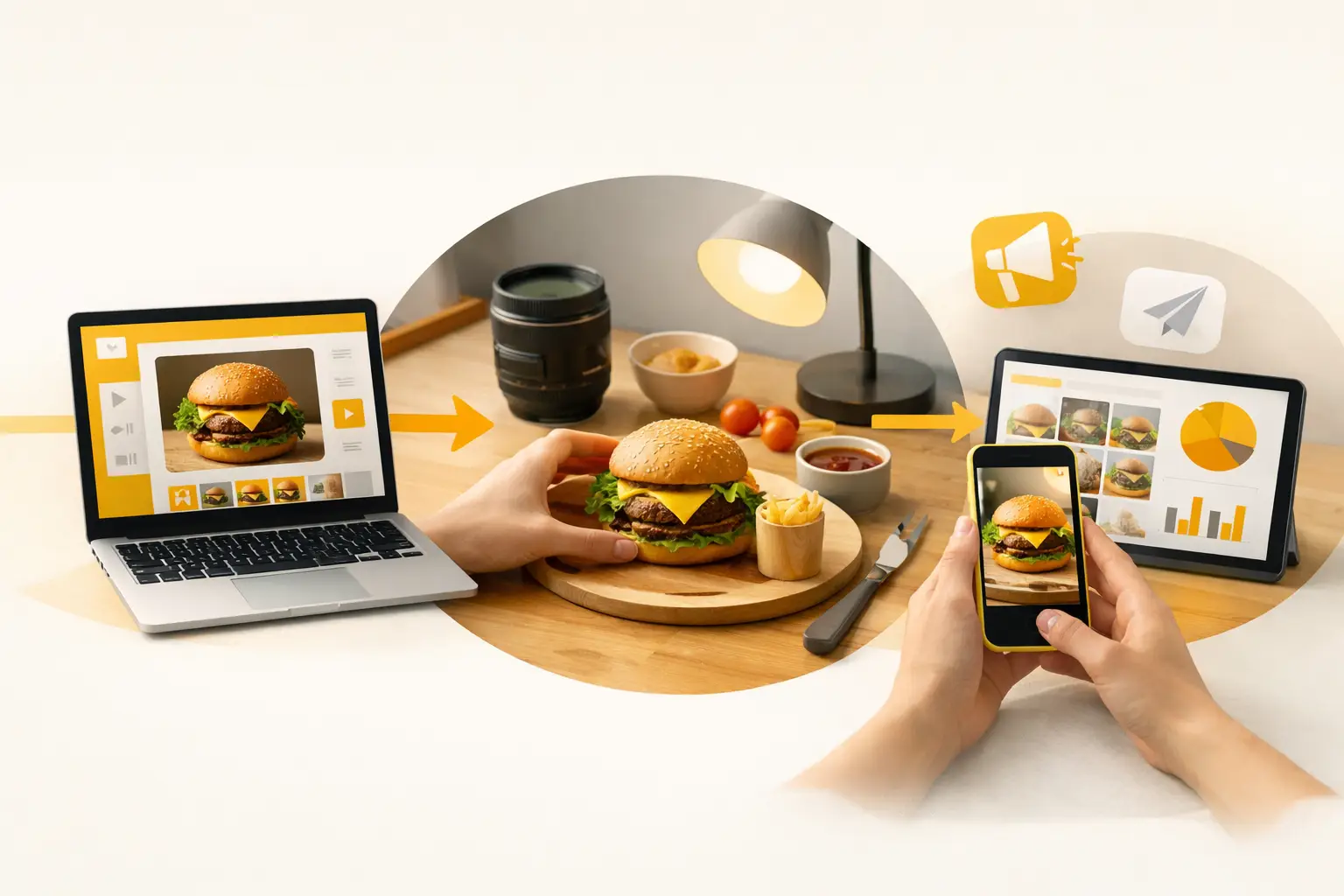
A paid social campaign rarely needs one perfect food photo. It needs a product-first square image, a vertical Story variation, a seasonal background, a promotional version with room for copy, and often short-form motion to match. A reliable food ad creative workflow turns those requests into a repeatable production system instead of a series of last-minute design tasks.
For restaurants, food brands, ghost kitchens, and agencies, the goal is not to replace every studio shoot. It is to produce more usable creative between shoots, test more angles before committing budget, and keep campaign visuals consistent as offers change.
Start With the Ad Job, Not the Image Prompt
The fastest creative teams begin with distribution and conversion goals. Before generating a single visual, define where the asset will run, what action it should support, and what must stay visible in the frame.
A delivery promotion has different requirements from a premium product launch. A delivery ad needs instant product recognition, generous space for offer copy, and a composition that survives a small mobile placement. A brand launch may need more texture, atmosphere, and visual restraint. Both can feature the same dish, but they should not begin with the same creative brief.
Build each brief around four operating decisions: the featured item, the audience or occasion, the placement, and the message hierarchy. For example, a burger campaign could target weekday lunch orders on Instagram Stories, with the burger centered low in frame and clear space above for a limited-time offer. That is specific enough to guide production without locking the team into one image.
This step also prevents a common issue with food advertising: visually strong content that leaves nowhere to place a headline, price, logo, or call to action. Food should be appetizing, but the ad still has a job to do.
Build a Food Ad Creative Workflow Around Reusable Inputs
A scalable workflow depends on preserving the decisions that make a brand recognizable. If every campaign begins from scratch, speed gains disappear in revision cycles.
Create a compact visual system for each brand or concept. Document the product details that cannot change, such as packaging shape, label placement, toppings, portion size, glassware, and brand colors. Then define the variables that can change: background color, serving occasion, prop set, lighting mood, crop, and camera angle.
This distinction matters. A packaged snack brand may want dozens of contextual scenes, but its package must remain accurate. A restaurant can test different tabletop environments and garnish treatments, yet its signature entrée should still look like the food customers expect to receive. The more clearly the fixed and flexible elements are separated, the easier it is to generate variety without losing brand control.
Create Campaign Families Instead of One-Off Assets
Treat every concept as a campaign family. Start with one hero composition, then create related variants for formats, offers, and audience segments. The visual language should remain connected even when the background or message changes.
A practical campaign family might include a clean product hero for menu or ecommerce use, a lifestyle-oriented version for social, a promotional image with negative space for paid ads, and a vertical motion asset for Stories or Reels. These are not four unrelated ideas. They are four outputs built from the same product, lighting direction, palette, and message.
This approach makes approvals faster because stakeholders review a system rather than debating every asset as a separate creative decision. It also gives media teams more options to test without requiring a new shoot for each placement.
Generate for Composition, Then Generate for Variation
The highest-volume teams do not chase endless prompts. They establish a strong composition first, then create controlled variations from that foundation.
Start with the frame. Decide whether the food should be overhead, at table level, tightly cropped, or shown in a wider serving context. Identify where copy will live and how much visual weight the product needs. For a discount-led ad, clarity usually beats complexity. For a premium beverage launch, reflected light, texture, and a more spacious composition may be worth the extra production time.
Once the core composition is working, vary one or two elements at a time. Change the background, prop styling, time of day, or crop while keeping the product and overall visual direction stable. This creates meaningful options that are easy to compare. Changing everything at once produces more images, but not necessarily better testing inputs.
Specialized food visual tools are useful here because food-specific controls and generation logic reduce the gap between an attractive concept and a commercially usable dish. Umami AI can support this process by helping teams create food-focused imagery and short-form visual assets without rebuilding the production setup for every variation.
Add Motion Only Where It Improves the Ad
Video is not automatically more effective than a still image. For some offers, a clean static product shot with a direct price message will outperform a busy animation. Motion earns its place when it makes the food feel fresher, explains the product faster, or better fits the placement.
Use short motion to emphasize sensory cues: cheese pulling, sauce pouring, steam rising, a drink being poured, or a close camera move toward the product. Keep the first second visually clear. On mobile feeds, viewers should understand the product before they need to interpret the scene.
The trade-off is production complexity. Motion assets need extra review for realism, frame consistency, and legibility once text is added. Build them from approved still compositions whenever possible. That keeps the visual identity stable and gives designers a reliable starting point for captions, offer cards, and end frames.
Review Against Commercial Standards, Not Personal Taste
Food ads often stall because feedback arrives as subjective language: “Make it pop” or “It doesn’t feel premium.” Those comments may be valid, but they do not tell a production team what to change.
A more useful review checks whether the food is recognizable at a glance, whether the product appears accurate, whether the scene supports the intended audience, and whether the layout leaves enough room for required messaging. Then review technical readiness: placement dimensions, readable copy space, logo visibility, and any product or offer claims that need approval.
Keep review rounds narrow. The first round should address composition and product accuracy. The second should address brand styling and copy placement. The final round should focus on export readiness. Combining all feedback into one late-stage review is how a simple ad turns into a week of revisions.
It also helps to set a threshold for “good enough to test.” Paid creative does not need to win an internal beauty contest. It needs to communicate the product, meet brand standards, and generate a clear learning signal. If two directions are both on-brand, put them into market rather than spending days choosing based on preference alone.
Organize Outputs for Fast Activation
The creative workflow is only complete when assets are easy to find, adapt, and launch. Name files by campaign, product, concept, placement, and version. Store source visuals with the exported variants so the team can return to an approved direction when a new promotion appears.
A simple structure prevents costly duplication. When a social manager needs a new weekend offer, they should be able to locate the approved burger hero, identify the vertical version, and request a new offer-ready variation instead of asking for a fresh concept. That is where production speed becomes operational value.
Track what happens after launch, too. Note which compositions earned stronger click-through rates, which product angles improved conversion, and whether motion added value for a specific audience or placement. Results should inform the next brief. Over time, the workflow becomes less about generating more content and more about generating the right content with fewer wasted iterations.
The best next step is small: choose one recurring promotion, define a campaign family around it, and build the first set of approved reusable inputs. Once that foundation exists, every future variation gets faster to produce and easier to put to work.