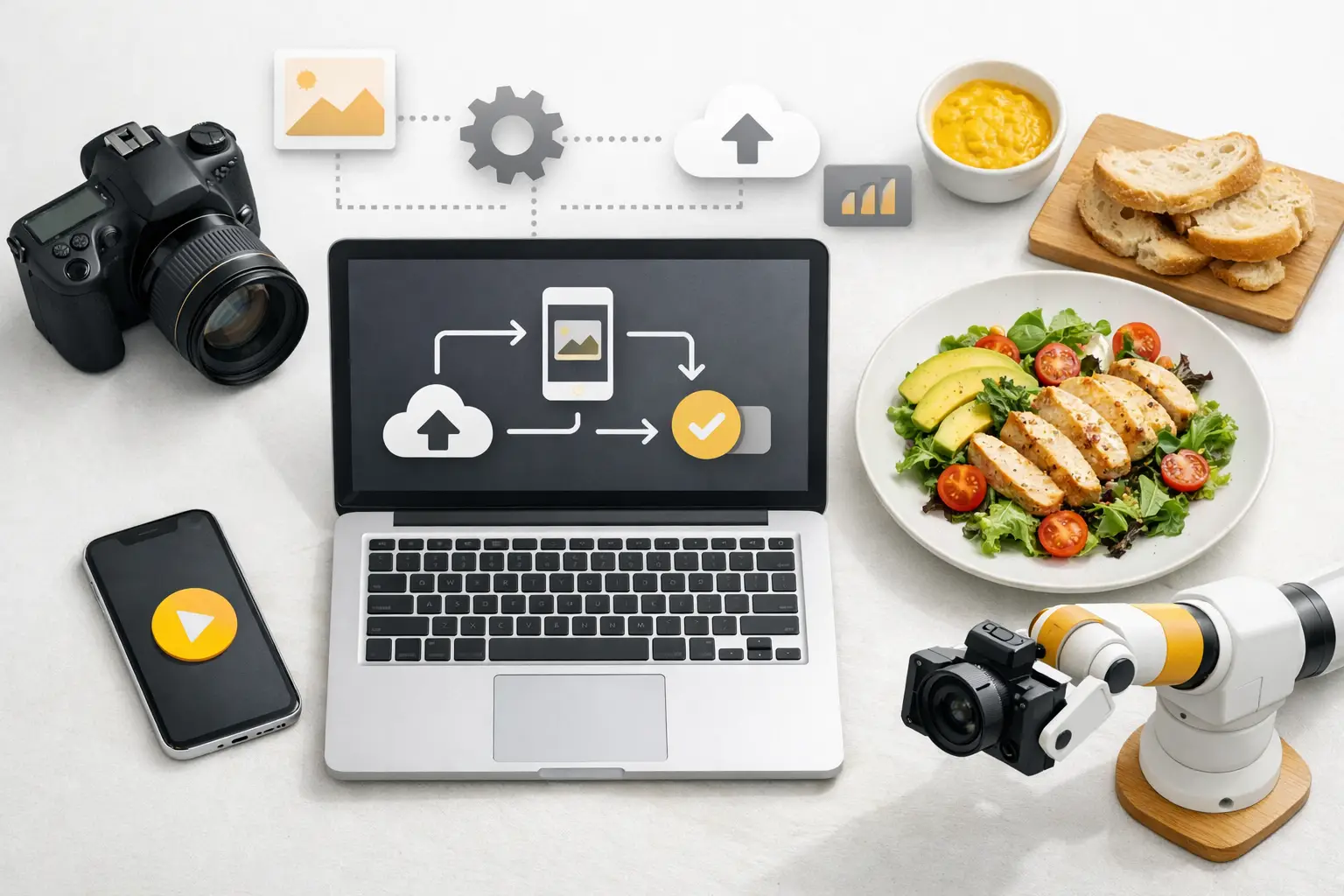
A restaurant group needs 40 new menu images by Friday. A beverage brand wants paid social variants for three audiences. An agency is juggling seasonal promos for six food clients at once. This is where food content automation software stops being a nice-to-have and starts acting like production infrastructure.
For food businesses, content demand is not occasional. It is constant. Menus change, campaigns rotate, channels multiply, and every format has different requirements. Static images, vertical video, product close-ups, lifestyle scenes, offer graphics, app thumbnails, and ad creative all compete for the same limited team time. Traditional production can still play a role, but it is too slow and too expensive to support every content need at scale.
Food content automation software solves a narrower, more operational problem. It gives brands and creative teams a way to generate food-focused visuals quickly, repeat styles across campaigns, and produce more assets without rebuilding the workflow every time. The key is not just automation for its own sake. The key is usable output at commercial speed.
What food content automation software actually does
At a practical level, food content automation software reduces the manual work behind repeatable visual production. Instead of organizing a new shoot, coordinating props, booking a photographer, editing raw files, and resizing outputs for every channel, teams can generate and adapt content inside one workflow.
That workflow usually includes image creation, composition control, style consistency, asset variations, and in some cases short-form motion. For food brands, the category focus matters. General AI tools can create attractive images, but they often miss the details that affect food marketing performance - texture, plating realism, ingredient clarity, packaging accuracy, and appetizing presentation.
This is why vertical software has an edge. A platform built specifically for food visuals is better aligned with the actual output needs of restaurants, CPG brands, ghost kitchens, delivery-first operators, and agencies serving those clients. It is not trying to be everything. It is trying to generate food content that is ready to use.
Why generic tools often break down for food teams
A general image generator may be fine for experimentation. It is less reliable when a business needs 25 ad variations that all feel on-brand, or a month of social creative that matches the same visual system. Food is one of the hardest categories to fake well because buyers notice details quickly. If cheese melts incorrectly, steam looks artificial, or a burger stack loses structure, the image stops feeling commercial.
There is also a workflow issue. Most marketing teams are not looking for a creative toy. They are looking for throughput. They need predictable credits or usage, clear output types, and a production path that makes sense for recurring work. That means composition tools, batch-friendly creation, and a practical way to move from brief to asset without extra friction.
The trade-off is straightforward. A general tool may offer broader experimentation, but specialized software is usually better for speed, consistency, and category-specific quality. If the business depends on food visuals every week, specialization tends to win.
Where food content automation software creates the most value
The biggest savings usually come from frequency. If your team only needs a hero campaign shoot twice a year, automation is useful but not transformative. If you need fresh creative every day across paid, social, email, app, web, and marketplaces, the economics change fast.
Restaurants can use it to refresh menu imagery, launch limited-time offers, and keep third-party delivery listings current without waiting on another shoot. Food brands can create campaign variants for promotions, retailer placements, and product launches. Agencies can handle more client volume without scaling production overhead at the same rate. E-commerce teams can build product-first visuals, seasonal assets, and channel-specific formats with less dependency on studio timelines.
This is also where cost efficiency becomes more than a budgeting argument. It is a speed argument. Faster production means more tests, more iterations, and more campaign responsiveness. That matters when creative performance changes weekly.
What to look for in food content automation software
The first requirement is output quality that holds up in a commercial setting. That sounds obvious, but many tools produce content that looks impressive in a demo and weak in a campaign. Food visuals need to feel appetizing, polished, and intentional. If the software cannot generate brand-ready assets, the rest of the workflow does not matter.
The second requirement is control. Teams need to guide composition, angles, backgrounds, styling direction, and format. Good automation does not remove creative control. It removes repetitive production steps while keeping the results usable.
The third is scalability. Look at how the platform handles credit usage, image volume, video generation, and plan tiers. A solo restaurant operator has different needs than a multi-brand agency, but both need clarity. If pricing is vague or usage is hard to predict, operations become messy.
The fourth is fit. Some platforms are built for broad creative exploration. Others are built for specific commercial categories. If food is the core use case, category fit usually delivers better results than a one-size-fits-all tool.
Food content automation software and the production stack
The smartest way to evaluate this software is not as a replacement for every creative process. It is better viewed as a production layer inside a larger marketing system.
A brand may still use traditional photography for flagship packaging, celebrity campaigns, or major retail launches. But that same brand can use automated food visual production for daily social, paid testing, promotional refreshes, marketplace assets, and concept generation. That split is often where the return becomes obvious.
The same applies to restaurants. A hero shoot for the website homepage may still make sense. Re-creating that level of production every time a combo meal changes usually does not. Automation fills the gap between premium campaign production and the nonstop demand for fresh content.
How specialized platforms change the economics
When software is purpose-built for food visuals, businesses can produce more assets from a smaller team without dropping visual standards. That is the real shift. Instead of treating every new image or clip as a mini production event, teams can operate on a system built for recurring output.
That is especially useful in credit-based models, where image and video generation map more directly to content volume. Teams can estimate usage, align subscriptions with workload, and add capacity when campaign demand spikes. For businesses that think in content calendars, ad sets, and monthly creative refreshes, that structure is easier to manage than the unpredictable cost of repeated shoots.
A specialized platform such as Umami AI fits this model because it is designed around food-first visual creation rather than generic image generation. That focus matters when the goal is not novelty but repeatable, professional output for real marketing channels.
When food content automation software is the wrong fit
It is not the right answer for every use case. If your brand needs exact product photography for regulated packaging claims, complex label compliance, or highly specific physical accuracy across every frame, manual production may still be necessary. The same goes for campaigns built around live talent, on-location storytelling, or highly bespoke art direction.
Automation also works best when teams have a clear visual objective. If the brand has no content standards, no campaign structure, and no approval process, software will not fix that. It accelerates production, but it does not replace strategy.
That is the main dependency to keep in mind. Better tools increase output. They do not automatically improve judgment.
The practical case for adoption
If your team regularly asks how to create more food visuals without adding more production complexity, the answer is usually not another patchwork process. It is a better system. Food content automation software gives businesses a way to generate, adapt, and scale assets with much less friction than traditional workflows.
For operators and marketers, the decision comes down to volume, speed, and quality. If content demand is rising and the current process depends on too many manual steps, specialized automation is no longer experimental. It is operational.
The teams that benefit most are not chasing novelty. They are building a faster engine for the content they already know they need next week.