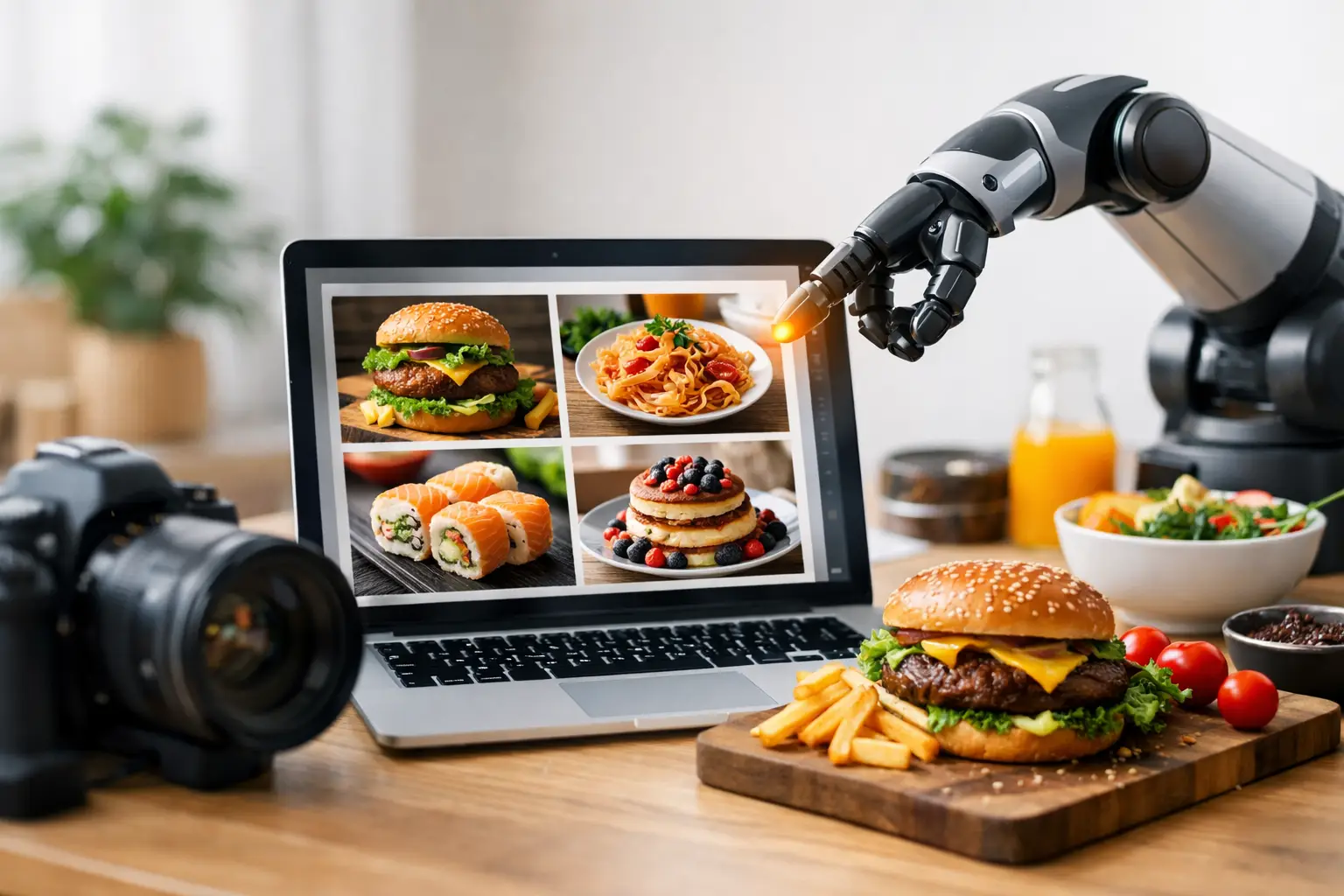
A new seasonal menu used to mean a shoot day, a stylist, ingredient sourcing, retouching, and a lot of waiting. For most food businesses, that process is too slow and too expensive to repeat every time a promotion changes. A food image generator AI changes that equation. It gives restaurants, food brands, agencies, and e-commerce teams a faster way to produce polished visuals built for commercial use.
The real value is not novelty. It is throughput. If your team needs ten hero images for a landing page, twenty social posts for the month, and a fresh set of ad creatives before the weekend, speed matters. So does consistency. General image tools can generate attractive pictures, but food marketing has its own standards. Texture, plating, lighting, portion realism, packaging accuracy, and appetite appeal all carry more weight when the product itself is the sale.
What a food image generator AI actually solves
Most teams do not have a creativity problem. They have a production bottleneck. The challenge is getting enough usable food visuals without rebuilding the entire content pipeline every time a campaign shifts.
A specialized food image generator AI reduces the usual friction points. You can create assets without booking a studio, coordinating props, or waiting on post-production. That is especially useful for operators who need ongoing output rather than one big annual brand shoot. Restaurants updating delivery platforms, beverage brands testing paid social, and agencies managing multiple accounts all benefit from a workflow that supports volume.
There is also a cost structure advantage. Traditional photography still has a place, especially for flagship campaigns or exact packaging documentation, but it comes with fixed costs that are hard to justify for routine content. AI-generated food visuals are more flexible for testing, iteration, and mid-cycle updates. If a promo underperforms, the creative can change quickly instead of staying locked because the shoot already happened.
Why specialized tools outperform generic AI for food
Food is one of the easiest categories to get almost right and one of the hardest to get commercially right. A generic image model may deliver something visually interesting, but that does not always translate into a usable asset for a menu board, product page, or ad set.
Specialized food systems are built around the details that matter in this category. They handle common food compositions more reliably, produce imagery that feels more appetizing, and make it easier to maintain a repeatable visual style across assets. That matters if your brand needs the same burger to look on-brand in a web banner, a vertical story placement, and a printed promo.
This is where niche focus becomes practical rather than theoretical. A platform designed specifically for food can streamline generation, composition, and even animation around the exact use cases food marketers deal with every week. Instead of adapting a broad creative tool to your process, you start with something that already understands the category constraints.
Where food image generator AI fits in the content stack
For commercial teams, AI visuals work best when treated as part of the production system, not as a one-off experiment. The strongest use cases are the ones tied directly to content demand.
Menus and ordering platforms are an obvious fit. Operators can produce cleaner, more consistent visuals for featured items, limited-time offers, and category headers without organizing repeated shoots. Social teams can create seasonal posts, launch teasers, and promotional variations faster, which is useful when content calendars move quickly.
Paid media is another strong application. Ad performance often improves through variation, not just through one perfect image. A food image generator AI makes it easier to test backgrounds, compositions, product angles, and campaign moods at a scale that would be expensive to produce manually.
E-commerce teams also benefit because product pages need more than a single pack shot. They need appetite-led hero images, lifestyle-style compositions, bundle visuals, and campaign-specific variants. AI can help fill those gaps quickly, especially when sales cycles require constant refreshes.
What to look for in a commercial workflow
Not every AI image tool is built for business use. If your goal is reliable output, the workflow matters as much as the image quality.
Start with control. You need enough prompt and composition flexibility to direct the outcome, but not so much complexity that every asset becomes a design project. Teams usually want a system that can move from concept to usable visual in minutes, not one that demands advanced experimentation for every result.
Consistency is next. A single strong image is easy to celebrate. A hundred on-brand images across channels is harder. Commercial teams should look for workflows that support repeatable styles, campaign continuity, and efficient revisions. If your visual identity changes accidentally from asset to asset, the speed benefit starts to disappear.
Credit logic matters too. In subscription-based platforms, image creation and video creation often run on usage. That model works well when it is transparent. Marketing teams need a clear sense of how many assets a plan can realistically support, when extra credits are needed, and whether the pricing aligns with their output volume. A starter plan may work for a single location or solo creator, while a higher tier makes more sense for agencies, multi-unit operators, or brands running constant campaigns.
The trade-offs you should be realistic about
AI is fast, but fast is not the same as perfect. Teams using a food image generator AI should expect to review outputs with a commercial eye.
If your product has strict legal, packaging, or franchise brand requirements, human review remains essential. Exact ingredient representation, regulated claims, and SKU-level precision still need oversight. For some use cases, especially when the image must match a product exactly as sold, traditional photography or a hybrid workflow may still be the better choice.
There is also a difference between campaign content and documentation. AI is excellent for concepting, promotion, visual variation, and branded marketing assets. It is less suited to situations where the image must function as literal proof of the final physical item. Smart teams separate those use cases instead of expecting one tool to cover everything.
The other trade-off is process discipline. AI lowers production effort, but it can also increase content volume so quickly that teams publish too much inconsistent work. The fix is simple: treat generation as a structured workflow. Define your visual standards, campaign goals, formats, and approval process before scaling output.
How teams get the best results
The strongest results usually come from teams that think like operators, not hobbyists. They begin with the channel and objective. Is this image for a homepage hero, a delivery app tile, a paid social test, or an in-store promotion? Once the use case is clear, the creative direction gets sharper and the generation process becomes more efficient.
It also helps to build around repeatable visual systems. Instead of inventing a new look every time, set parameters for lighting style, color treatment, framing, and background approach. That makes campaign production faster and creates a cleaner brand presence across touchpoints.
Short-form motion is becoming part of that same workflow. Static food imagery still carries most of the load for menus, product pages, and display ads, but animation is increasingly useful for social placements and digital promotions. A platform that supports both image and video generation can reduce handoff friction and keep the output style aligned.
For teams producing at scale, this is where a food-specific platform has an advantage. The tool is not just generating attractive visuals. It is supporting a production model built around recurring demand, credit-managed output, and commercial readiness. That is a different requirement from casual image generation.
Food image generator AI is becoming an operations tool
The bigger shift is that AI-generated food content is moving out of the experimental category. It is becoming part of routine marketing operations. Businesses are using it to keep up with promotional cycles, reduce production lag, and maintain a steady flow of creative across channels.
That is why the best evaluation question is not whether AI can make a nice food image. It can. The better question is whether it can support your content volume, brand standards, turnaround times, and budget model. If the answer is yes, then it is no longer just a creative add-on. It is part of how the business ships marketing.
For food brands and operators that need speed without losing polish, a focused platform such as Umami AI fits that commercial reality better than a broad tool built for everything. The category is specific, the output demand is constant, and the workflow needs to be efficient.
If your team is still treating food content production like a series of isolated projects, this is a good time to rethink it. The companies moving faster are the ones building systems that can produce great visuals on demand, not just when a shoot finally gets on the calendar.