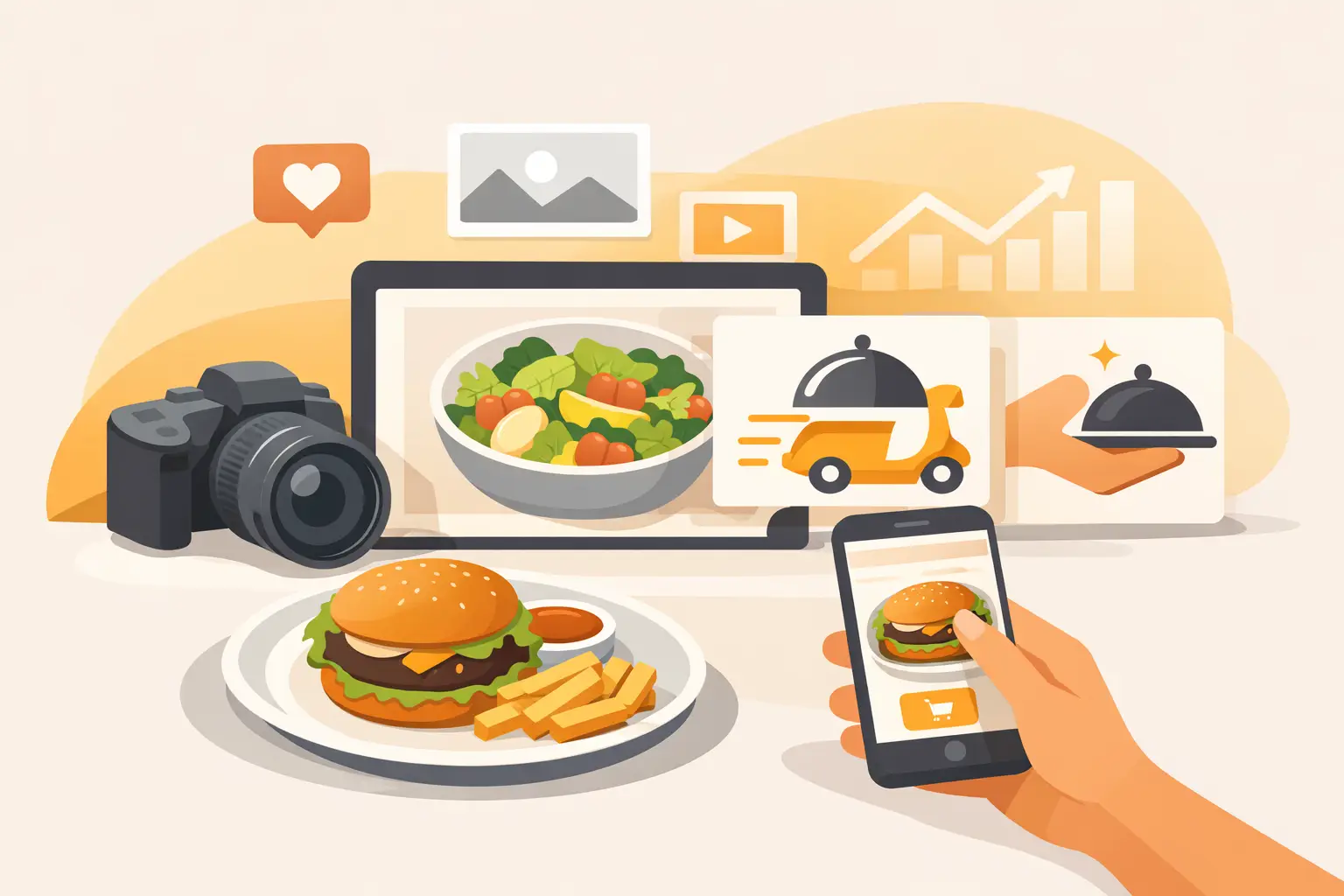
A blurry hero shot, inconsistent lighting, and one generic product image reused everywhere - that is often where food campaigns start losing money. Food marketing visuals are not a finishing touch. They affect click-through rate, menu appeal, ad performance, and whether a customer feels confident enough to buy.
For restaurants, packaged food brands, ghost kitchens, and e-commerce teams, the real issue is not whether visuals matter. It is how to produce enough of them, fast enough, without turning every campaign into a photo shoot budget problem. That is where a more scalable visual workflow starts to matter.
Why food marketing visuals affect revenue
Food is a category where visual quality does immediate commercial work. Customers do not taste first. They evaluate appearance, portion cues, freshness, texture, color, and presentation in seconds. If the image underperforms, the offer underperforms with it.
That makes food different from many other product categories. A software screenshot can be functional. A food image has to create appetite and trust at the same time. It needs to look desirable, but still believable enough to support the brand promise. If the dish looks flat, oversaturated, or obviously artificial, conversion can drop even if the copy and offer are strong.
This is why food teams often see better results when visuals are treated as a performance asset rather than a brand accessory. Menu boards, paid social, landing pages, delivery apps, email campaigns, and product listings all compete for short attention spans. Strong visuals improve the odds that a customer stops, looks, and acts.
What strong food marketing visuals actually need to do
The best-performing assets usually do three jobs at once. First, they make the food look appetizing. Second, they make the product easy to understand. Third, they stay consistent with the brand across channels.
That balance matters because an image can fail in different ways. Some visuals are polished but vague. They look attractive, yet do not clearly communicate what the customer is buying. Others are descriptive but unappealing, which hurts engagement. Then there are visuals that look good in isolation but do not match the rest of the brand library, creating friction across ads, menus, and social content.
For commercial teams, this means the goal is not just pretty imagery. The goal is usable output. Assets need to fit real placements, real campaign timelines, and real brand systems.
Appetite comes from detail
Food imagery works when it captures sensory cues. Steam, gloss, texture, crisp edges, melting cheese, fresh garnish, condensation on a drink - these details help a viewer imagine taste and freshness. In practical terms, they make the image feel more immediate.
But this is also where overproduction can hurt. If everything is hyper-stylized, the food may stop feeling edible. There is a difference between enhancement and distortion. For some brands, especially fast casual or delivery-first concepts, realism tends to perform better than heavily dramatized visuals. For premium packaged goods or launch campaigns, a more art-directed look may be worth it. It depends on the channel, the audience, and the price point.
Clarity beats clutter
A food visual should answer a basic customer question fast: what am I getting? If the composition is overloaded, the image may look busy instead of compelling. Clear framing, a readable focal point, and a background that supports rather than competes with the food usually perform better.
This matters even more in mobile placements. A social ad or delivery listing gets only a fraction of a second. In that context, visual simplicity is not a style preference. It is a usability requirement.
The production problem behind food marketing visuals
Most food businesses do not struggle because they lack ideas. They struggle because producing enough visual assets is slow, expensive, and operationally messy.
Traditional food photography can deliver high-end results, but it comes with constraints. You need planning, scheduling, styling, lighting, editing, and often multiple stakeholders. If the campaign changes, the packaging updates, or the seasonal menu rotates, the process starts again. For brands with frequent launches or high SKU counts, this becomes a bottleneck.
Generic design tools and broad AI image platforms solve part of the speed problem, but they introduce another issue: inconsistency. Food is highly specific. Small errors in texture, proportions, plating, ingredient relationships, and material surfaces make outputs look off. A general-purpose tool may generate a decent image occasionally, but not with the repeatability commercial teams need.
This is why specialized workflows matter. A vertical platform built for food content has a clearer commercial role. It can reduce setup time, improve output relevance, and make it easier to create multiple campaign-ready variations without rebuilding the process from scratch.
How to scale food marketing visuals without losing quality
The most effective approach is not replacing every existing creative process. It is removing the slowest parts.
Start with the assets you need most often. For many teams, that means product hero images, promotional variations, seasonal campaign creatives, short-form motion assets, and formatted visuals for social and web placements. These are the pieces that need constant refreshes and often do not justify a full production cycle every time.
From there, consistency becomes the main operating principle. A scalable workflow should help teams maintain the same visual standards across channels while still generating enough variation for testing. That means controlling composition, styling direction, aspect ratios, and campaign themes without creating a one-off asset every single time.
This is where AI-assisted production is practical, not theoretical. If a team can generate food-specific imagery and video variations inside a defined workflow, they can move faster on launches, promotions, and channel testing. Instead of waiting for the next shoot, they can create assets when the business actually needs them.
For example, a restaurant group may need different visuals for paid ads, menu panels, and social promos built around the same item. An e-commerce brand may need a clean product-forward image for the PDP, a lifestyle variation for ads, and a short motion asset for retention campaigns. The core product stays the same, but the output format changes. A flexible food-focused system handles that better than a static asset library.
Where AI fits into commercial food content
AI is useful when it shortens production time and expands output volume without creating more cleanup than it saves. That is the real threshold.
For some use cases, traditional photography still makes sense. Signature brand campaigns, packaging launches with strict legal requirements, or flagship assets for major retail distribution may still need a full production setup. But not every creative need belongs in that category.
A large share of visual demand is operational. Teams need more variants, faster turnarounds, and lower production overhead. They need to test offers, support local promotions, refresh stale creatives, and adapt imagery across formats. In those situations, speed and consistency often matter more than building a perfect hero shot from scratch.
That is why a specialized platform such as Umami AI has a practical advantage. It is built around food image and video generation for commercial use, which makes the workflow more relevant to the actual job: producing brand-ready assets at volume, with less friction than recurring shoots or broad creative tools.
What to look for in a food visual workflow
If you are evaluating how to improve food content production, the useful question is not whether the tool is impressive. It is whether it fits the demands of the business.
A workable system should let you generate enough assets for ongoing campaigns, maintain a consistent visual standard, and support multiple output types without excessive redesign. It should also be easy to understand operationally. Marketers need to know what they can produce, how usage scales, and when it makes sense to move to a higher-capacity plan or buy additional credits.
That commercial clarity matters. Creative teams do not just need image quality. They need predictable throughput. If a platform supports both stills and short-form video, along with structured usage levels for lighter and heavier production needs, it becomes easier to match output to campaign demand.
The right setup also depends on team size. A solo restaurant owner may need a simple self-serve workflow for social posts and menu promos. An agency or in-house brand team may need higher volume, collaboration, and more room for testing. The best solution is usually the one that reduces production drag without forcing the team into a process they will not keep using.
Food is sold with the eyes first, but the business impact comes from what happens after the image is made. Better visuals are useful when they help teams publish faster, test more often, and keep quality high as demand grows. That is the standard worth aiming for.