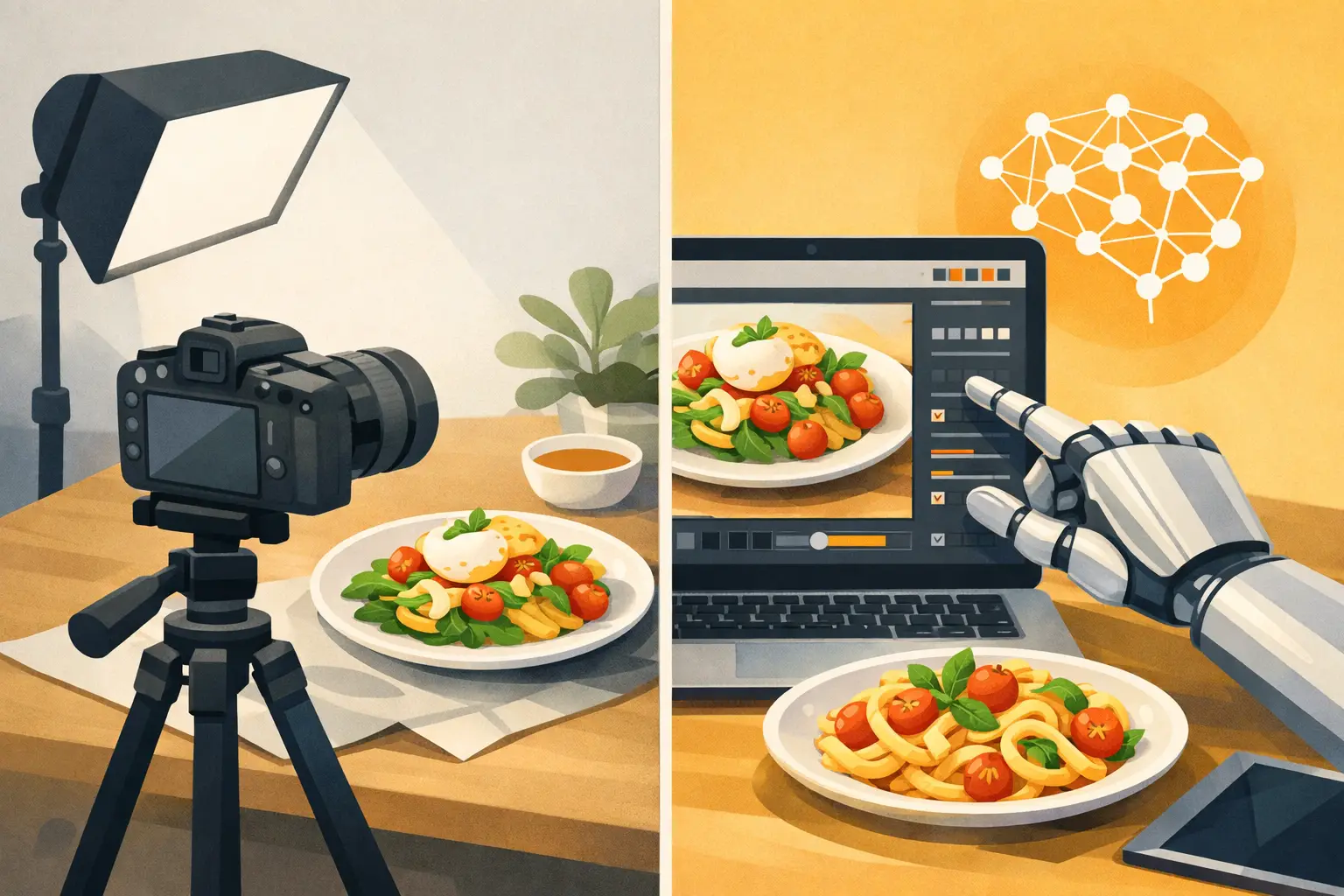
A seasonal menu launch used to mean booking a photographer, sourcing props, coordinating prep, styling dishes, and hoping every shot made the schedule worth it. That is exactly why food photography vs AI has become a practical business decision, not just a creative one. For restaurants, food brands, agencies, and marketing teams under pressure to publish more visuals across more channels, the real question is not which option is more impressive. It is which workflow produces usable assets faster, more consistently, and at a cost that makes sense.
Food photography vs AI: what actually changes
Traditional food photography is still the benchmark for capturing a real product in a real setting. If you need exact packaging details, a hero shot of a signature dish, or highly controlled brand imagery for a national campaign, a professional shoot gives you physical accuracy that matters. You are documenting something that exists, with a camera pointed at it.
AI changes the production model. Instead of organizing a shoot, you generate the visual based on direction, composition goals, styling choices, and output requirements. That cuts out much of the time and logistics tied to studios, food prep, reshoots, and post-production. For commercial teams, that is the main shift. AI is less about replacing the camera in every situation and more about replacing slow, expensive production steps when speed and scale matter more than physical capture.
This is where the comparison gets useful. Food photography and AI are not just two ways to make an image. They solve different operational problems.
Cost is not just the shoot day
When teams compare costs, they often look at the day rate for a photographer and stop there. In practice, traditional production includes much more. There is planning, crew time, styling, ingredients, props, location or studio fees, editing, and the internal time required to coordinate everything. If one campaign needs ten variations across formats, backgrounds, and seasonal themes, costs rise quickly.
AI has its own cost structure, but it is usually far easier to predict. You are paying for usage, access, and output volume rather than production logistics. That changes the economics for teams that need a steady stream of menu images, paid social creatives, website banners, app visuals, or promo content. The more often you need fresh content, the more traditional photography starts to feel like a bottleneck rather than a premium asset.
That said, lower cost does not automatically mean better value. If the image needs to be legally exact, or if the audience will expect the photographed item to match the final product down to shape and garnish placement, photography may protect the brand better. Cost only matters when paired with the right use case.
Speed is where AI has the clearest edge
Most food businesses are not producing one perfect image per quarter. They are producing weekly specials, delivery app updates, seasonal offers, ad variants, product launches, email banners, social posts, and short-form creative for testing. In that environment, speed has direct commercial value.
A photo shoot runs on a schedule. AI runs on demand. That difference affects more than convenience. It affects campaign timing, approval cycles, and how many creative directions a team can test before launch. If marketing wants three visual angles for the same promotion by end of day, photography is rarely the efficient path.
AI also reduces the friction around iteration. You can adjust plating, mood, lighting style, crop, background, and format without rebuilding a set or cooking another dish. For teams managing multiple locations or product lines, this matters. Fast iteration often produces better final assets because the team can test more options before committing.
Quality depends on what "quality" means
This is where the debate usually gets sloppy. People say photography is more authentic and AI is faster, but that only tells part of the story. Commercial quality is not one fixed standard. It depends on where the image will appear and what job it needs to do.
For packaging, investor materials, national campaigns, or highly regulated product claims, photography often has the advantage because it can represent the exact item being sold. For social ads, menu boards, concept development, promotional graphics, and fast-turn website updates, AI can deliver quality that is more than sufficient and often more flexible.
There is also a consistency advantage with specialized AI workflows. Traditional shoots can vary based on crew, lighting setup, availability, and post-production style. AI, when used well, can help teams maintain a tighter visual system across repeated outputs. That is especially useful for brands trying to scale content without having every asset feel like it came from a different vendor.
The trade-off is that AI quality depends heavily on the workflow behind it. Generic image tools can produce food that looks attractive at first glance but falls apart on inspection - awkward textures, unrealistic ingredients, inconsistent plating, or a style that does not fit a commercial brand. A specialized platform built for food content is more likely to produce assets that look usable rather than merely interesting.
Control means different things in each workflow
Photography gives you physical control. You can choose the actual plate, the real garnish, the packaging angle, the surface texture, and the lens setup. For many brand teams, that level of specificity is worth paying for when the image needs to be definitive.
AI gives you directional control at a much higher speed. You can move from rustic cafe lighting to bright e-commerce composition to premium editorial styling without rebuilding a set. You can generate multiple formats and concepts from the same visual intent. That is a different kind of control, but for marketers it is often the more useful one because it aligns with campaign production rather than studio production.
If your team cares more about exact representation, photography wins. If your team cares more about rapid variation, scalable output, and format flexibility, AI usually wins. Most businesses need both types of control at different times.
Food photography vs AI in real commercial use
For a restaurant group updating seasonal promotions every month, AI is usually the practical choice for producing visual volume. The team can create assets for social, in-store screens, delivery platforms, and paid ads without organizing a shoot every cycle.
For a packaged food brand launching into retail, the answer is more mixed. The hero packaging shot may still need photography, especially when labels and product appearance must be exact. But supporting creative for campaigns, mood-based promotions, and concept testing can often be handled far faster with AI.
For agencies, the advantage is capacity. AI can expand output without expanding production overhead. More concept routes, more ad variations, faster client turnarounds. That does not eliminate photography. It reduces how often photography is the only option.
For independent operators, the comparison is usually simpler. If the choice is between inconsistent DIY content and scalable branded visuals, AI can create a far more usable system than occasional phone photos or infrequent professional shoots.
The smartest teams do not treat this as either-or
The strongest production model is often hybrid. Use photography for flagship assets, exact product representation, and key brand moments. Use AI for volume, variations, seasonal promotions, channel-specific formats, and quick-turn creative testing.
That approach keeps quality where it matters most while removing unnecessary production friction everywhere else. It also helps marketing teams move faster without waiting on a full studio process every time a campaign shifts. In practice, this is how many businesses will get the best return - not by choosing one side permanently, but by assigning each tool to the job it handles best.
A specialized platform like Umami AI fits this model well because it is built around food-specific output rather than general image generation. That matters when the goal is not just to create pretty visuals, but to create food assets that are commercially usable across ads, menus, websites, and short-form campaigns.
Which option should your business choose?
If you need exactness, photography is still the safer choice. If you need speed, volume, and flexibility, AI is hard to beat. If you need both, use both deliberately.
The better question is not whether AI can replace food photography across the board. It cannot, and it does not need to. The better question is where photography is still essential and where AI removes cost and delay without hurting performance.
For most food businesses, that line is getting clearer. The more content you need, the more often AI becomes the operational advantage. And when your creative workflow starts matching the pace of your marketing calendar, you stop treating visuals like a production problem and start using them like a growth tool.