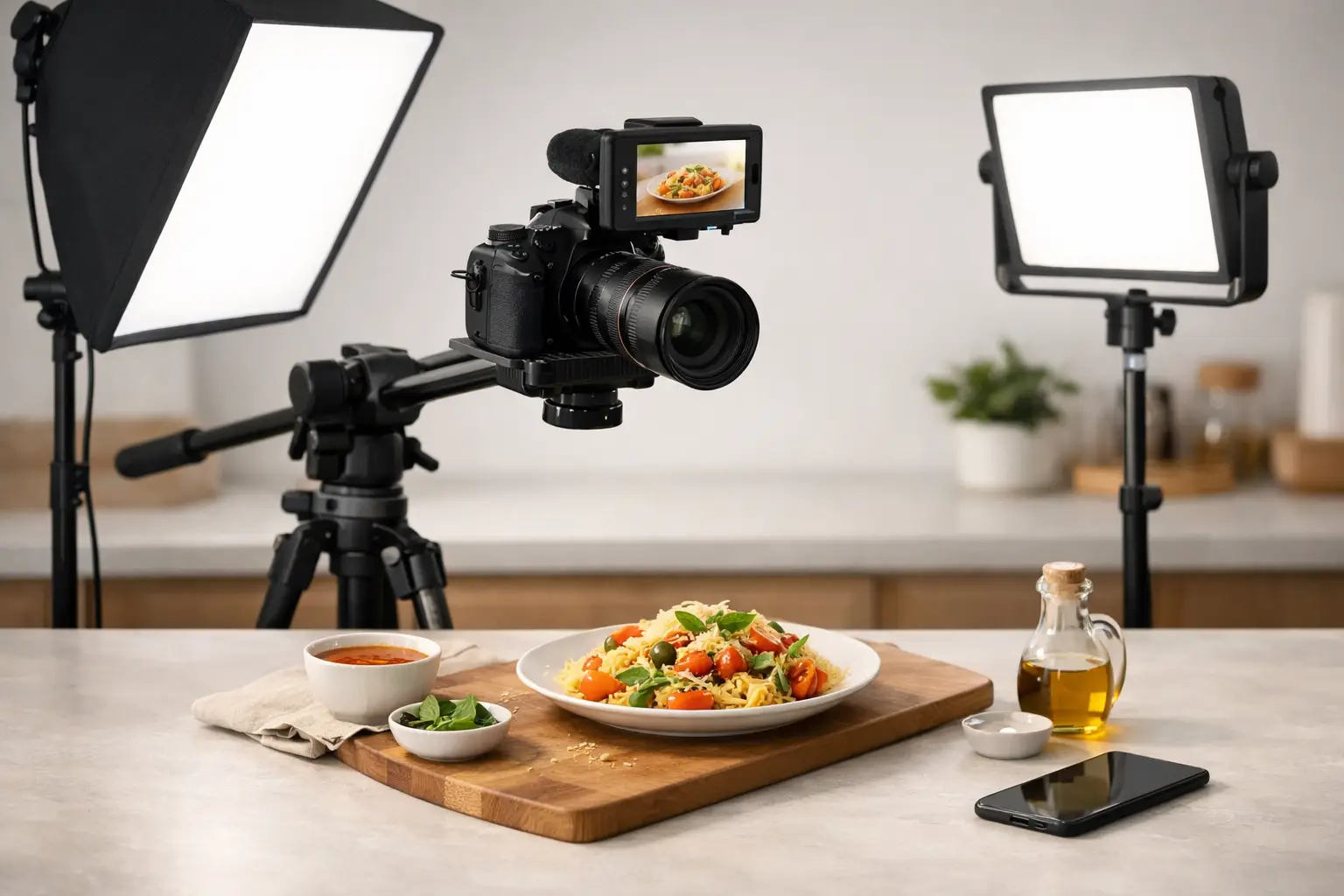
The fastest way to slow down food content production is to overbuild your food video setup. Too many teams buy gear first, then realize they still do not have a repeatable process for shooting menu items, promos, and short social clips on schedule. If the goal is commercial output, the setup needs to reduce friction, not add more of it.
For most food businesses, the right setup is not the most expensive one. It is the one that gives you clean footage, reliable color, and a workflow your team can run more than once. A restaurant marketing manager, a beverage brand, and an agency producing 20 variations for paid social all need slightly different configurations. The common requirement is simple: produce appetizing video assets quickly, keep the look consistent, and avoid rebuilding the shoot every time.
What a food video setup actually needs to do
A commercial food video setup has one job: create footage that is usable across channels with minimal reshoots. That means stable framing, predictable lighting, and a surface area large enough to support styling without creating visual clutter. If your content is headed to Instagram Reels, TikTok ads, menu boards, product pages, and email campaigns, the setup has to support both vertical and horizontal capture or make cropping painless.
That changes the buying logic. You are not shopping for filmmaking prestige. You are building a controlled production system. The camera matters, but less than many teams assume. Lighting, mounting, and speed of reset usually decide whether a setup is productive or frustrating.
Start with output, not equipment
Before choosing gear, define the footage you need every month. A ghost kitchen pushing weekly LTOs needs fast overhead and close-up shots of plated items. A CPG brand may need ingredient pours, packaging hero shots, and looping motion clips for paid media. A restaurant group may need a high volume of short item videos that all look like they belong to the same brand family.
This is where teams often miss the trade-off. A flexible setup can shoot many styles, but it usually takes longer to configure. A fixed setup gives you less creative range, but much higher output. If you need content at scale, fixed wins more often than not.
A practical baseline is to define three things: your most common shot angle, your main aspect ratio, and your average production time per item. Once those are clear, equipment decisions become easier and cheaper.
The core food video setup: keep it lean
Most commercial teams can get strong results with a simple rig. You need a camera or current smartphone that records sharp video, a sturdy tripod or overhead mount, two soft light sources, a controllable background, and a small styling zone. Add a reflector, diffusion, and basic color control, and you have the foundation for repeatable work.
The main question is whether your setup is fixed around a prep table, a studio corner, or a portable cart. Fixed setups are better for consistency. Portable setups are useful for restaurants that need to shoot in active spaces with limited room. The more often you move the rig, the more time you spend rebalancing exposure, white balance, and framing.
For many brands, a smartphone is enough if the lighting is stable and the mount is solid. Dedicated cameras give more control over depth and lens choice, but they also create more complexity for teams that need quick handoff between operators. If multiple people will shoot, ease of use matters as much as raw image quality.
Camera choice depends on volume
If you shoot occasionally, a newer phone with manual control apps can handle most menu and social work. If you shoot every week and need stronger lens options, cleaner low-light performance, or more precise matching across campaigns, a mirrorless camera is a better long-term choice.
The trade-off is operational. Phones are faster and easier to deploy. Mirrorless systems give you more control, but they ask for more discipline with settings, battery management, and media handling. Teams producing at scale should standardize one capture method and stick with it.
Lighting is where consistency comes from
Food looks expensive or cheap based on lighting long before viewers notice camera specs. Soft directional light usually works best because it adds shape without making sauces, glaze, or packaging highlights feel harsh. Two soft lights are enough for most setups: one key light and one fill or bounce source.
Daylight from a window can look great, but it is hard to scale because it changes by hour, season, and weather. If you need repeatable output, use controlled artificial light. Set one color temperature, mark fixture positions, and keep them locked. That one decision removes a surprising amount of editing time.
Mounting and angles matter more than people expect
The best food video setup often includes two stable angles: overhead and 45-degree. Overhead works for assembly, ingredient placement, and top-down table scenes. A 45-degree angle feels more dimensional and tends to work better for burgers, drinks, sandwiches, and plated dishes with visible height.
A flexible overhead arm saves time if you use top-down shots often. If your tripod is difficult to reposition, your team will avoid useful angles and settle for whatever is fastest. That eventually shows up in the content.
Build for repeatability, not one perfect shoot
The most efficient setups are boring in the right way. Tape marks on the floor. Fixed light positions. Saved camera settings. A known hero zone where dishes are placed. Standard backgrounds that fit the brand. These choices are not glamorous, but they create output.
A lot of food teams still treat content production like a mini campaign every time. That is expensive. It also creates inconsistency across ads, product pages, and organic social. If your fries are warm and golden in one video and flat and gray in the next, the problem is usually not editing. It is the setup.
This is also where AI-assisted workflows fit naturally. If you need high output across multiple items, promotions, or concepts, not every asset needs a full physical shoot. Teams increasingly blend a physical food video setup with AI-generated visuals to cover gaps, test variations, or create campaign-ready food motion without resetting a studio for every new idea. For operators focused on speed and scale, that hybrid model is often more efficient than choosing one method exclusively.
Common setup mistakes that cost time
The biggest mistake is mixing uncontrolled ambient light with studio lights. It creates color shifts that are annoying to fix and easy to miss until you compare clips side by side. The second is using a background that looks good for one dish but fights every other product. Neutral surfaces generally scale better.
Another common problem is underestimating styling space. If your frame is tight but your production area is cramped, every garnish, sauce brush, and prop change becomes slower than it should be. Give yourself enough room around the hero area to work cleanly.
Sound is another it depends category. If your food videos are mostly visual with music or text overlays, you can ignore on-set audio. If you need pour sounds, sizzles, or prep action, then your setup needs basic sound control. That can be as simple as reducing kitchen noise and using a directional mic close to the action.
A scalable food video setup for small teams
If you are running lean, aim for a setup that one person can operate in under 10 minutes. That usually means one fixed table, two soft lights, one overhead solution, one angled camera position, and a short list of approved surfaces and props. Your system should make yes easy. If every shoot needs a debate about lenses, backdrops, or color grading, the setup is too open-ended.
For agencies and larger in-house teams, the focus shifts from simplicity to throughput. That may mean duplicate lighting kits, prebuilt shot templates, and versioning rules for platform outputs. The idea is the same: remove avoidable decisions so creative time goes toward the food, not the hardware.
A strong setup is not defined by how much gear is in the room. It is defined by how quickly your team can create useful footage that matches your brand standards. When the system is working, launches move faster, paid creative gets refreshed more often, and content stops depending on a single perfect shoot day.
The best next move is usually not buying more equipment. It is tightening the workflow around the shots you need most, then expanding only when the output justifies it.