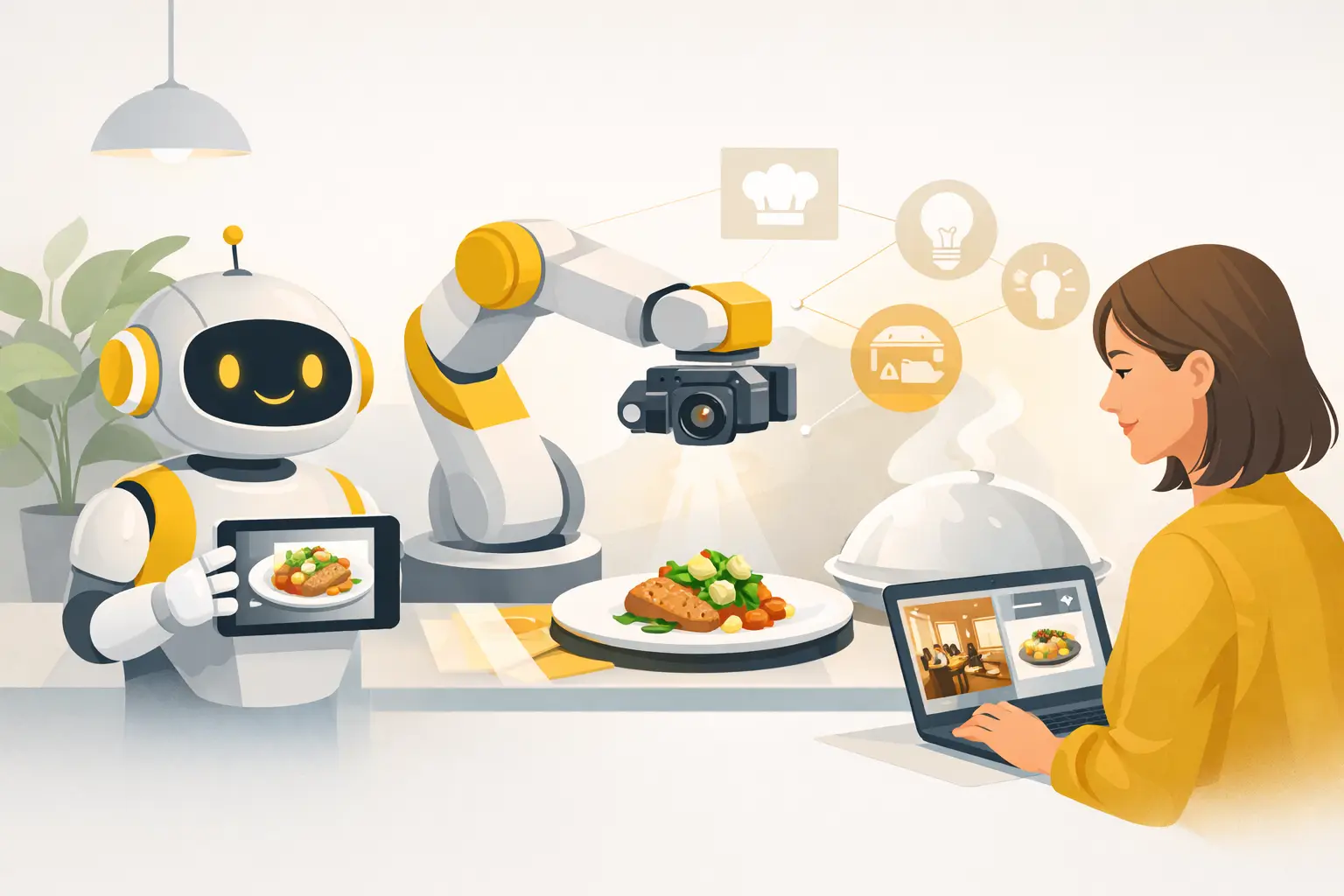
Last-minute promo going live tomorrow, no fresh photos on hand, and your designer is already buried. That is exactly where a guide to AI restaurant creatives becomes useful - not as a trend piece, but as an operating system for producing food marketing assets faster.
Restaurants and food brands do not need more generic content. They need visuals that sell a specific dish, match a real brand, and fit the channel they are buying media on or publishing to. AI can help with that, but only if the workflow is built around commercial output instead of novelty.
What a guide to AI restaurant creatives should actually cover
A useful guide to AI restaurant creatives starts with one basic distinction: restaurant content is not the same as general brand content. Food visuals have a shorter attention window, a tighter connection to conversion, and much less room for visual mistakes. If the burger looks dry, the drink glass looks warped, or the plating changes across assets, the image stops performing.
That is why restaurant teams should think about AI creative production in terms of repeatability. One good image is helpful. Fifty on-brand assets for campaigns, menu boards, paid social, delivery apps, landing pages, and seasonal promos is where the real value shows up.
The strongest AI workflow for restaurants usually sits between traditional photography and generic AI image generation. Photography still matters for hero assets, packaging accuracy, and high-stakes brand launches. Generic AI tools can be flexible, but they often require more trial and error to get food right. A food-specific workflow tends to reduce that waste because the model, prompts, and output expectations are already aligned with commercial food imagery.
Start with use case, not technology
Most teams make the same mistake early. They start by asking what AI can create instead of asking what the business needs this week.
For restaurants, the needs are usually straightforward. You may need lunch promo graphics for social, fresh imagery for a third-party delivery listing, ad variants for a limited-time offer, or motion content for short-form placements. Each one has a different production requirement. A static homepage banner needs polish and composition control. A social campaign may need multiple aspect ratios and quick versioning. A menu insert may need cleaner text-safe space and more restrained styling.
If you define the use case first, the creative standard becomes clearer. You can decide whether the asset needs photorealism, speed, product variety, animation, or strict consistency with existing brand visuals. That prevents overproduction and keeps credits, time, and approvals under control.
Build a system for consistency
The biggest commercial issue with AI restaurant creatives is not image quality. It is inconsistency.
A brand may love the first generated taco image, then realize the second one uses a different shell, a different lighting style, and an entirely different mood. That is a problem if those assets are meant to run in the same campaign. Restaurant marketing depends on recognition. Customers should feel like every visual comes from the same kitchen, not a different universe each time.
Consistency comes from setting production rules before generation starts. Define the dish angle, background style, lighting direction, prop density, color temperature, crop behavior, and level of realism. If you are producing across multiple products, define what stays fixed and what changes. For example, the surface and lighting can remain stable while the dish rotates by menu item.
This is where a structured platform matters more than an open-ended tool. A focused food workflow makes it easier to create visual families instead of isolated one-offs. For restaurant groups, agencies, and teams producing high asset volume, that difference affects both speed and approval rates.
Match creative to the channel
One food image does not fit every placement. That sounds obvious, but teams still waste time stretching one asset across every format.
Paid social usually needs bolder framing, stronger contrast, and room for fast visual comprehension on mobile. Website hero sections need a cleaner composition that can survive overlays and responsive cropping. Delivery app imagery often performs better when the food is direct, recognizable, and less stylized. Menu boards need clarity at a distance. Short-form video needs motion that supports appetite appeal rather than distracting from it.
AI works best when it produces for the destination, not after the fact. Instead of generating one master image and forcing it into five uses, build asset sets by channel. That can mean creating square, vertical, and wide variants in the same visual system, or producing static and animated versions from the same concept. The output is more usable, and the editing burden drops.
Use prompts like production briefs
Prompting for restaurant creatives should be treated like briefing a commercial shoot. Vague prompts produce vague results.
The better approach is specific and operational. Name the dish, portion style, camera angle, environment, lighting quality, composition intent, and business purpose. If the asset is for an upsell banner, say so. If it is meant to feel premium, late-night, family-friendly, or fast-casual, include that context. If the brand relies on minimal plating and neutral surfaces, that should be part of the input.
Good prompting is less about adjectives and more about constraints. "Appetizing" is too broad. "Top-down crispy chicken sandwich combo on matte stone surface with clean negative space on right for offer text" is much more usable.
This is also where teams should be realistic. AI can move fast, but it still benefits from direction. The time saved comes from reducing shoots, revisions, and production bottlenecks - not from skipping creative judgment.
Know where AI fits and where it does not
AI restaurant creatives are strong for campaign iteration, seasonal refreshes, concept testing, localized promos, social volume, and low-friction asset expansion. They are especially effective when a team needs more content than a normal shoot calendar can support.
There are still cases where traditional production is the better choice. If legal or packaging accuracy is strict, if the product shape must match exactly, or if the asset is tied to a major national launch, photography may still carry less risk. The same applies when a brand has highly proprietary plating or texture details that must be represented precisely.
The practical answer is often hybrid. Use photography for anchor assets and AI for scale, adaptation, and variation. That gives marketing teams room to move without rebuilding the entire visual pipeline around one method.
Think in volumes, credits, and approval cycles
For commercial teams, the value of AI is not just lower production cost. It is throughput.
If your team creates five assets a month, almost any process can work. If you need fifty, or five hundred across stores, offers, channels, and test campaigns, the economics change fast. You need a workflow that can support repeat generation, versioning, and short feedback loops.
That is why usage planning matters. Credit-based production forces a useful discipline: tie generation volume to campaign needs. Do not burn output on random experimentation if the actual requirement is six ad variants, three menu visuals, and two short product animations. Structured usage leads to better creative operations.
Approval logic matters too. When stakeholders know what the visual system is supposed to look like, they review faster. When every asset is a new style direction, approvals drag and the speed advantage disappears.
A practical framework for AI restaurant creative production
A simple framework works best. First define the business objective. Then define the channels, formats, and volume required. Build a narrow visual brief with clear consistency rules. Generate in sets, not singles. Review for appetite appeal, realism, and brand fit before distributing across placements.
After that, measure what actually performs. Some brands assume the most stylized image will win, but the result can go the other way. A cleaner product-forward shot may outperform a more cinematic one in delivery listings or local ads. Restaurant creative is full of these trade-offs. Better-looking is not always better-converting.
For teams that need food visuals at scale, a specialized platform like Umami AI can reduce friction because the workflow is already tuned to food image and video production rather than broad creative experimentation. That usually means less correction, faster output, and more commercially usable assets.
What success looks like
A good AI creative system should make restaurant marketing less fragile. Fewer delays waiting on shoots. Fewer campaigns held up because one visual is missing. More room to test offers, refresh seasonal content, and support every channel with assets that feel intentional.
The benchmark is not whether AI can make an attractive plate of pasta. The benchmark is whether your team can reliably produce campaign-ready visuals that fit the brand, fit the format, and fit the timeline.
If that is the target, the best guide to AI restaurant creatives is simple: treat AI like a production layer, not a gimmick. When the process is structured, the output becomes useful. And useful is what keeps a restaurant marketing engine moving.