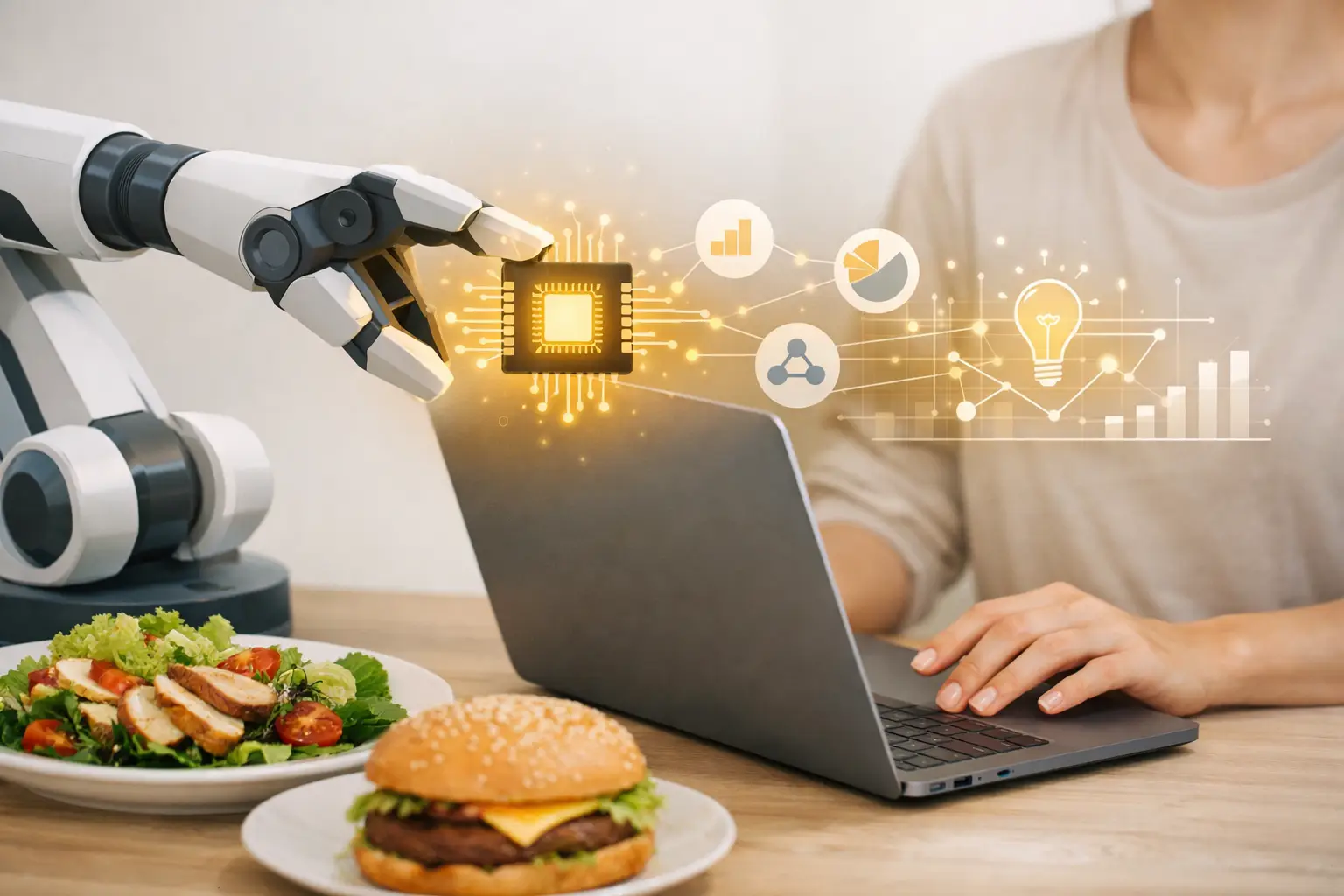
The gap is widening between food brands that can produce fresh assets every week and those still planning around the next photo shoot. That is one reason food companies using ai are pulling ahead. They are not just experimenting with automation. They are using it to move faster on content, forecasting, product decisions, and day-to-day execution.
For operators and marketers, that shift matters because the pressure is constant. Menus change. Promotions need creative. Seasonal campaigns have short windows. Product teams need packaging mockups and launch visuals before a physical sample is even ready. AI is becoming less of a trend story and more of a production system.
Where food companies using AI are getting real value
The strongest use cases are not the most futuristic ones. They are the places where teams lose time, overspend, or hit bottlenecks. In food businesses, that usually means visual production, demand planning, customer analysis, and workflow speed.
On the marketing side, AI helps teams create more output without building a bigger studio process. A restaurant group can generate menu imagery for digital boards, paid social, delivery listings, and email campaigns without coordinating a new shoot for every promotion. A packaged food brand can test multiple visual directions for product launches before spending on final production. For lean teams, that speed changes what is possible in a normal week.
On the operations side, AI is showing up in forecasting, inventory, and pricing decisions. Food businesses have always dealt with narrow margins and demand volatility. Better predictions can reduce waste, improve ordering, and help teams react faster to local patterns. That does not mean AI replaces planning discipline. It means teams get a stronger starting point.
There is also a quieter but important benefit - consistency. When brands scale across locations, channels, and campaigns, consistency is expensive to maintain manually. AI systems can help keep product descriptions, visuals, and promotional assets aligned with the same brand standard.
The biggest shift is in food content production
For many commercial teams, the fastest return comes from content. That is especially true for restaurants, CPG brands, beverage companies, ghost kitchens, and e-commerce sellers that need a steady stream of food visuals.
Traditional food photography still has a place. If you are shooting flagship packaging, national campaign creative, or hero assets for a major retail launch, a full production team may still be the right call. But not every asset needs that process. Most businesses need volume more often than they need a once-a-quarter masterpiece.
That is where AI changes the economics. Instead of organizing talent, props, kitchen prep, lighting, retouching, and revisions for every campaign, teams can create brand-ready food visuals much faster. They can produce variations for formats, offers, audiences, and seasonal moments without restarting from zero each time.
For commercial teams, the practical benefit is simple. More output, shorter turnaround, lower production friction.
A niche tool matters here. Generic image generators can create attractive images, but food is a category where details decide whether something looks usable or off-brand. Texture, portioning, plating, steam, garnish, packaging fit, table styling, and ingredient realism all matter. That is why specialized platforms such as Umami AI are relevant to this market. The value is not just generating an image. It is generating food-specific assets that feel commercially usable.
AI is changing how food brands test ideas
One of the most useful advantages of AI is not final production. It is pre-production.
Food companies regularly need to test concepts before committing budget. That might be a new product look, a promotional angle, a packaging direction, or a seasonal menu treatment. In a conventional workflow, early-stage testing is often limited because mockups take time and money. Teams either move slowly or make decisions with incomplete visuals.
AI gives them a faster way to pressure-test ideas. Marketers can compare campaign directions. Product teams can visualize new flavors or bundle concepts. Agencies can present stronger concepts earlier. Franchise groups can localize creative more efficiently. The speed of iteration improves the quality of decision-making.
There is a trade-off, though. Fast iteration can also lead to excess. Teams can generate endless options and delay decisions instead of improving them. The businesses getting value from AI usually set clear creative constraints, brand rules, and approval paths. AI works better when the system around it is disciplined.
Why operations teams care too
Marketing gets the attention because it is visible, but many food companies using AI are applying it deeper in the business. Demand forecasting is a clear example. Better predictions help restaurants and food retailers balance stock, labor, and promotions with fewer surprises. For categories with short shelf life, even small gains matter.
Menu analysis is another area with practical upside. AI models can help identify which items drive margin, which combos increase order value, and which descriptions improve conversion on digital ordering platforms. That does not remove the role of operator judgment. Local context still matters. Weather, events, competition, and customer behavior can shift quickly. But AI can surface patterns that are easy to miss manually.
Customer support and back-office automation also belong in this conversation. Food brands handling high order volume can use AI to streamline response workflows, classify issues, and improve service speed. Used well, that reduces repetitive work. Used badly, it creates frustrating customer experiences. The difference usually comes down to oversight and where a business keeps a human in the loop.
What separates useful AI adoption from expensive noise
A lot of AI rollouts fail for a simple reason: the tool is interesting, but the workflow is unclear. Food businesses do better when they start with one expensive problem and measure whether AI actually improves it.
If the issue is content bottlenecks, the question is not whether AI can generate images. The question is whether your team can produce campaign-ready food assets faster, at lower cost, and with acceptable brand consistency. If the issue is waste, the question is whether forecasts improve enough to affect purchasing and spoilage. If the issue is menu performance, the question is whether insights lead to better pricing, bundling, or merchandising.
That sounds obvious, but it matters. AI should be judged by output quality, speed, cost, and operational fit. Not novelty.
The other separator is specialization. Food businesses have category-specific needs. A generic tool may handle broad tasks, but specialized systems are often better aligned to the actual work. In visual production, for example, teams need assets that match food styling expectations, channel requirements, and campaign timelines. That is a different requirement from general creative experimentation.
Where the trade-offs show up
AI is not a universal upgrade. It depends on the asset, the workflow, and the risk tolerance.
For highly regulated packaging claims, final legal review still matters. For premium brand campaigns, human art direction still matters. For menu photography tied to exact in-store presentation, accuracy standards may be stricter than what some teams can accept from AI-only workflows. Businesses need to decide where speed is the priority and where precision has to lead.
There is also the question of team adoption. A tool that saves time for marketing may create confusion if brand rules are not documented. A forecasting model may look promising but fail if store-level inputs are inconsistent. AI tends to amplify the quality of the system around it. Clear processes usually get better results than ad hoc usage.
That is why the best implementations are usually narrow at first. One workflow. One team. One measurable outcome. Then expansion.
What this means for food businesses right now
The practical case for AI in food is getting stronger because the need is immediate. Brands are under pressure to publish more, test more, react faster, and control costs at the same time. AI helps when it removes production drag without lowering the quality bar too far.
For visual content, the opportunity is especially clear. If your team needs food imagery for ads, menus, social, websites, delivery apps, packaging concepts, or short-form campaigns, AI can compress a process that used to require much more time and coordination. That does not eliminate traditional production. It gives you another operating mode.
The companies moving fastest are not treating AI like a side experiment. They are fitting it into commercial workflows with clear expectations around speed, consistency, and output volume. That is a more useful frame than asking whether AI will change the industry. It already is.
The better question is whether your current process can keep up with the amount of content and decision-making your business now requires. If not, this is the moment to build a faster system.