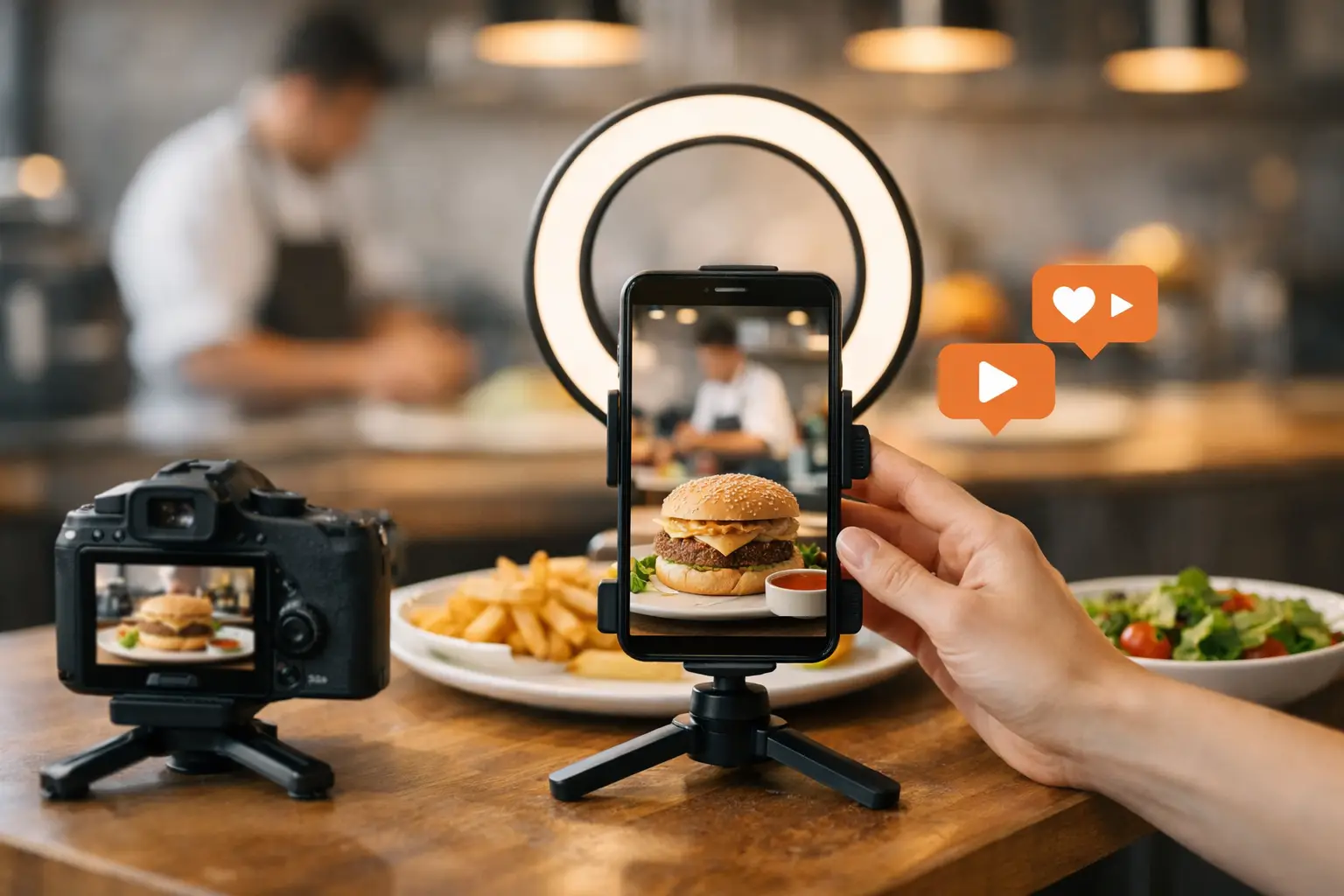
Most restaurant reels fail in the first second. Not because the food looks bad, but because the video feels slow, messy, or generic. If you want to know how to make restaurant reels that actually earn attention, the answer is not more filming. It is a tighter production system, better visual decisions, and content built for repeatable output.
For restaurants, short-form video is not a branding extra. It is a volume channel. You need enough content to support launches, promos, seasonal items, paid ads, organic social, and last-minute posts when service is slow and traffic needs a push. That changes how you should approach reels. The goal is not to create one perfect video. The goal is to create a process that reliably produces strong food content without slowing down operations.
How to make restaurant reels without wasting time
The fastest way to improve restaurant reels is to stop treating each one like a standalone creative project. Build around repeatable formats instead. A burger pull, a cocktail pour, a plated pasta close-up, a before-and-after prep shot, a limited-time offer reveal - these are formats, not one-off ideas. Once a format works, run it again with different menu items.
This matters because most restaurants do not have the time, staff, or budget for constant original production. A useful reel workflow should let you create in batches, swap in new visuals, and publish consistently. If every reel needs a new concept, a new shoot, and a new edit, your content output drops fast.
A practical standard is to work from three content buckets: product-focused reels, process-focused reels, and offer-focused reels. Product reels sell the food. Process reels show freshness, prep, or finishing details. Offer reels support bundles, new items, specials, or events. That mix gives you enough variety without forcing constant reinvention.
Start with the shot, not the caption
If the visual does not stop the scroll, the rest does not matter. Restaurant reels are decided visually before they are understood verbally. That means your first priority is getting a strong opening frame.
The highest-performing food hooks tend to be tight, specific, and texture-heavy. Think steam rising off noodles, glaze hitting fried chicken, cheese stretching, sauce drizzling, ice cracking in a drink, or a knife breaking through a crisp crust. Wide dining room shots can work for atmosphere, but they rarely outperform close food detail unless the setting itself is the product.
When deciding what to shoot, ask one question: what is the appetite trigger here? Sometimes it is motion. Sometimes it is shine, melt, crunch, or color contrast. Not every dish is naturally dramatic, so you may need to frame the reel around assembly, garnish, or the final pass rather than the static plate.
A common mistake is starting with a logo screen, a staff intro, or a text-heavy opener. That adds friction. Lead with the food, then layer in the brand.
Build reels around one clear outcome
A restaurant reel should do one job well. It can drive cravings, introduce a new item, support a promotion, or reinforce brand consistency. It should not try to do all four at once.
This is where many teams overcomplicate the edit. They add too many clips, too much text, and too many messages into 15 seconds. The result feels crowded and underpowered. If the reel is for a lunch special, show the lunch special. If it is for a new dessert, stay on the dessert. A cleaner message usually performs better because the viewer immediately understands the point.
There is also a trade-off here. Broader reels can feel more polished and “brand right,” but narrower reels often convert better because they are easier to process. For paid usage especially, specificity usually wins.
How to make restaurant reels look polished on a small budget
You do not need a full production crew to make strong restaurant reels, but you do need consistency. The biggest difference between amateur and professional-looking food video is not usually the camera. It is control.
Control the lighting first. Natural light can work well, but only if it is stable. Mixed lighting, overhead glare, or deep shadows make food look dull fast. If you are filming regularly, a simple fixed setup with reliable soft light saves more time than trying to correct bad footage later.
Control the background next. Busy counters, cluttered prep stations, random packaging, and unreadable signage all weaken the frame. Food content performs better when the eye has a clear focal point. Clean surfaces, intentional props, and a limited color palette make the dish look more premium without adding much cost.
Then control pacing. Restaurant reels usually work best when every shot earns its place. A fast cut style can help, but speed alone does not create quality. The sequence still needs visual logic: hook, detail, payoff, offer. If the reel jumps between unrelated moments, it feels like spare footage stitched together.
For brands producing content at scale, generated visuals and AI-assisted food animation can reduce the burden of constant live filming, especially for menu concepts, promo assets, and variations needed across campaigns. That is where a specialized food workflow has an advantage over generic content tools. You can move faster while keeping the visuals aligned with commercial food marketing standards.
Use a simple reel structure that repeats
If you are figuring out how to make restaurant reels efficiently, use a structure that your team can repeat every week.
A strong default is this: start with the appetite hook, move into one or two supporting detail shots, show the final product clearly, then end on the offer or brand cue. That could all happen in 8 to 15 seconds. For example, open on a sizzling grill shot, cut to sauce application, cut to the plated burger, then finish with a limited-time text overlay.
That structure works because it matches how viewers process food content. First they feel the pull, then they verify what they are looking at, then they decide whether it is worth remembering or acting on.
You do not need complicated transitions. In fact, over-editing often hurts food content because it distracts from texture and product clarity. Clean cuts, strong framing, and controlled motion are usually enough.
Text overlays should support the sale
Text in restaurant reels should clarify, not narrate. Too much text turns the reel into a slide deck. Too little text can leave the offer unclear. The right balance depends on the goal.
For product-first reels, use short overlays like “new,” “back this week,” “limited drop,” or the item name. For promotional reels, focus on the buying message: two-for-one, weekday lunch combo, happy hour, family meal, online order only. Keep it readable and keep it brief.
Captions matter less than many teams think, especially in the first seconds. They can help add context, but the reel itself should carry the message. If the viewer needs the caption to understand the food or the offer, the creative is doing too much work after the scroll decision has already happened.
Post for volume, then optimize for winners
Restaurants often wait too long to post because they are trying to perfect every reel. That slows learning. A better model is to publish at a steady clip, identify the formats that consistently hold attention, and then make more variations of those.
This is a production problem as much as a creative one. If your team can only make one reel every two weeks, you will not gather enough signal to know what actually works. If you can create multiple versions from one concept - different menu items, different openings, different offers - you improve both output and performance insight.
Watch for practical metrics, not vanity alone. Views can be misleading. Saves, shares, profile actions, and direct order impact usually tell you more. A reel with lower reach but stronger conversion value can be more useful than a high-view clip that attracts passive engagement.
It also depends on the restaurant type. A fast-casual brand may benefit from high-frequency item drops and promo-led reels. A fine dining concept may need fewer, more selective posts with stronger atmosphere and plating detail. The right content tempo is tied to your business model, average ticket, and customer behavior.
Make the workflow fit the restaurant
The best answer to how to make restaurant reels is not “film better.” It is “build a system your restaurant can actually maintain.” If your team is small, simplify formats and batch production. If you manage multiple locations, standardize shot lists and visual style. If you run frequent offers, create templates that let you swap items and pricing quickly.
Content that depends on perfect conditions is hard to sustain in a real restaurant environment. Service gets busy. Staff rotates. Menu items change. Lighting shifts. A practical reel workflow accounts for those constraints instead of pretending they do not exist.
That is why the smartest restaurant content operations think like production teams, not just social teams. They reduce setup time, reuse proven structures, and generate enough visual inventory to support both day-to-day posting and campaign spikes. Tools built specifically for food content can help compress that workflow even further, especially when you need polished visuals at scale without organizing another shoot.
A good reel should make someone hungry. A good system should make the next 20 reels easier.