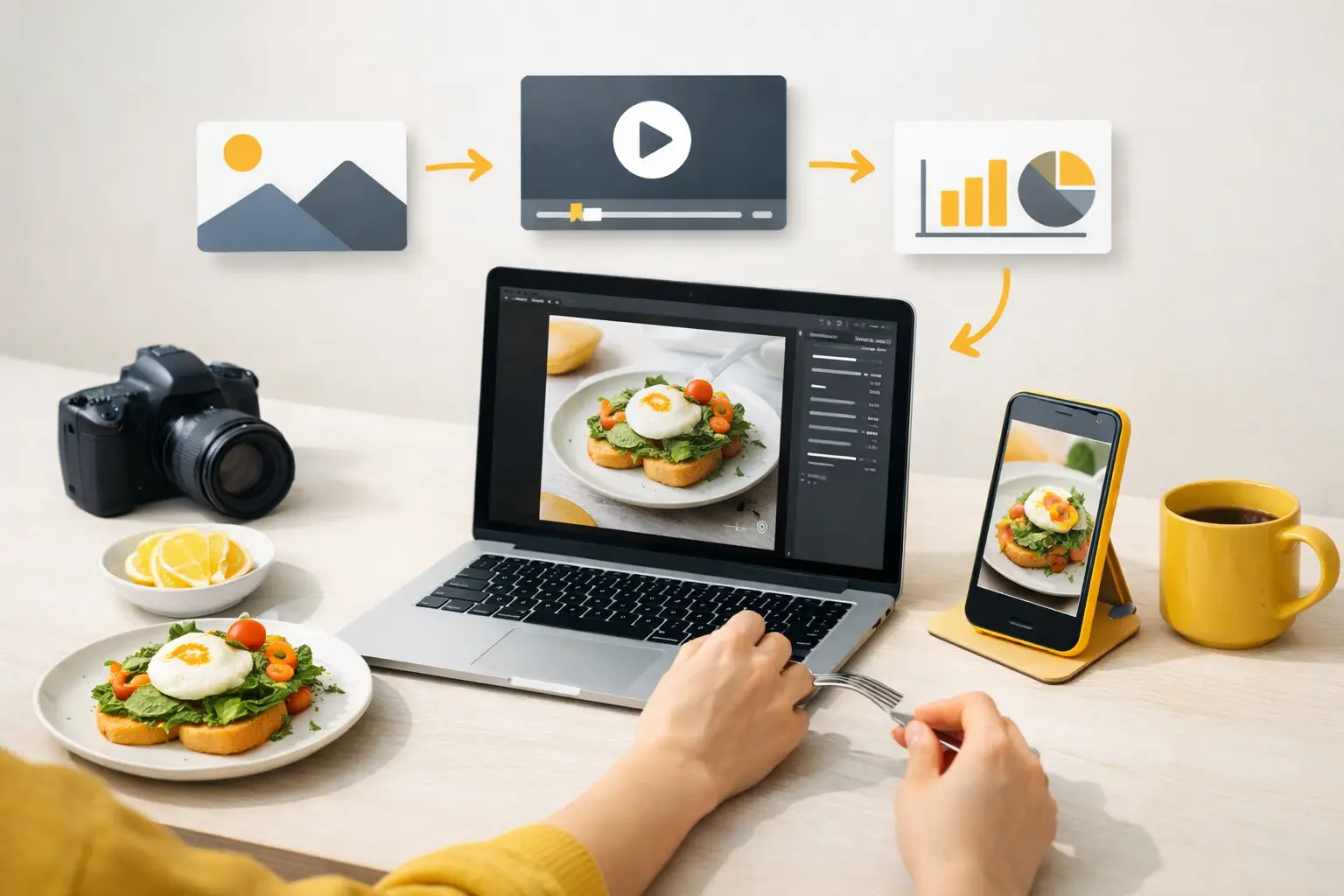
A new seasonal drink, limited-time menu item, retail promotion, and weekend social calendar can all land on the same week. The question is not whether you need more visuals. It is how to scale food content without turning every campaign into a new photo shoot, new round of revisions, and new production bottleneck.
For food businesses, content volume is rarely the only problem. The real challenge is producing enough on-brand assets for every channel while keeping dishes recognizable, colors consistent, claims accurate, and approvals moving. A beautiful one-off image does not solve that problem. A repeatable production system does.
Start With a Content System, Not a Posting Calendar
A posting calendar tells your team when to publish. A content system tells your team what can be produced quickly, reused intelligently, and approved with minimal friction.
Begin by separating your content into repeatable asset types. A restaurant may need menu hero images, social posts, paid ad variations, delivery-app imagery, email banners, and promotional graphics. A packaged food brand may need product-on-white images, lifestyle scenes, recipe visuals, retailer-ready assets, and launch creative. These are different outputs, but they should not require a completely different creative process each time.
Define a small set of visual formats for each asset type. For example, a menu hero might always use a three-quarter angle, clean surface, visible garnish, and room for pricing. A social image might prioritize vertical framing, stronger color contrast, and an immediate close-up. The goal is to reduce creative decisions that do not materially improve performance.
This is where many teams lose time. They ask for "something fresh" without defining what must stay consistent. Freshness should come from the offer, styling variation, seasonal context, or campaign message - not from rebuilding the production process every week.
Build a Visual Brief Your Team Can Reuse
The fastest way to create inconsistent food content is to brief every request from scratch. Instead, create a standard visual brief that captures the non-negotiables for a brand, product line, or location.
Include the food item or product, serving size, key ingredients that must be visible, preferred angle, background direction, lighting style, crop requirements, and intended channel. Add brand rules such as color palette, prop limits, packaging treatment, and whether text will be added later.
A useful brief also identifies what cannot happen. If a burger must not include tomato, say so. If beverage packaging must use current artwork, specify it. If a product is sold as a two-pack, do not leave the quantity open to interpretation. Food visuals can look polished and still create commercial problems when they misrepresent the product.
For recurring content, turn the brief into a template with selectable options. A campaign manager should be able to choose "summer patio," "dark premium tabletop," or "bright delivery promo" rather than write a new paragraph of creative direction. This gives non-designers a practical way to request usable work while protecting the brand system.
Treat ingredients and packaging as source-of-truth details
AI-assisted production can accelerate output, but it does not remove the need for review. The closer an image is to a specific product claim, package, or menu item, the more carefully it should be checked.
Use approved product references for packaging, brand marks, portion sizes, and signature ingredients. Then establish a final review step for details that affect customer expectations: allergen-sensitive ingredients, nutrition-oriented positioning, limited-time offers, and regulated claims. Speed matters, but accuracy protects trust.
Produce in Campaign Batches
Single-asset production is expensive because setup time repeats. The more efficient model is to organize work around a campaign, menu update, or product launch and produce a full asset family at once.
If a new chicken sandwich is launching, do not make one social image and call it done. Create the core visual direction, then generate the variations needed across the funnel: a high-impact vertical image for social, a square version for paid placements, a landscape crop for web, a menu-ready hero, and a detail shot that highlights texture or ingredients. The food, styling, and campaign idea stay aligned while the framing changes for the placement.
Batching also makes review easier. Stakeholders can approve one visual direction before the team produces every variation. That is far more efficient than receiving scattered requests from social, ecommerce, and operations teams that each interpret the product differently.
A practical batch has three layers. First, create the hero image that establishes the campaign. Next, create channel-specific crops and compositions. Finally, create controlled variations in background, garnish, prop styling, or copy space so media teams can test creative without drifting from the brand.
Use AI for Volume, Not Randomness
AI food visual tools are most valuable when they sit inside a clear production workflow. They can help teams create more concepts, compositions, and asset variations without booking a studio for each request. But using AI without constraints often produces visual noise: attractive images that do not match the menu, campaign, or brand.
Set up prompt structures that mirror your approved brief. Keep the product description, camera angle, lighting direction, environment, format, and negative constraints in a consistent order. This makes outputs easier to reproduce and easier for multiple team members to generate.
For example, a restaurant group can standardize a prompt framework around the dish, plate style, lighting, surface, and crop. Each location or promotion can then change only the relevant fields. A beverage brand can do the same for bottle orientation, condensation level, flavor cues, color environment, and ad placement.
Specialized platforms such as Umami AI are useful here because the workflow is built around food visuals rather than general-purpose image creation. The operational advantage is not just generating an appealing plate. It is producing campaign-ready food imagery in volume with more control over composition and output needs.
Create a Content Library That Teams Can Actually Find
Scaling production without organizing assets simply creates a larger mess. Store approved visuals with a naming system that makes them searchable by product, campaign, format, date, channel, and usage status.
Avoid vague file names like "final_final_2" or folders organized only by month. A marketer looking for a vertical image of a specific product should not need to open twenty files to find it. Use names that indicate exactly what the asset is: product name, campaign, orientation, channel, and version.
Your library should also distinguish between evergreen assets and time-sensitive content. Evergreen images can support menus, website pages, and recurring ads for months. Promotional images tied to a price, holiday, seasonal packaging, or limited-time product need expiration rules. This prevents old promotions from reappearing in ads or social scheduling tools.
Repurpose the concept, not just the crop
Repurposing is more than resizing a square image into a vertical frame. The most effective teams reuse the same campaign concept across different messages.
A close-up of melted cheese can support a social teaser. The full plated dish can support the menu. A wider table scene can support a lifestyle email. A motion variation can support a short paid video. One creative direction becomes a coordinated set of assets, each designed for its placement rather than forced into it.
That approach increases output while giving customers a more consistent experience as they move from ad to website to ordering page.
Tighten Approvals Before You Add More Production
Content does not scale when five people can request changes without a final decision-maker. More assets only amplify the delay.
Assign clear ownership for creative direction, product accuracy, and final publish approval. These can be different people, but the order should be fixed. First confirm that the food and offer are accurate. Then confirm that the asset fits the brand and channel. Finally, approve placement-specific copy or promotional details.
Set review standards in advance. Ask reviewers to evaluate the same questions each time: Is the product accurate? Does the image meet the campaign objective? Is the crop right for the channel? Is there enough space for text if needed? Does the image require legal, franchise, or retailer review? Clear criteria produce useful feedback. Open-ended comments create rework.
It also helps to define what requires a new asset versus a simple edit. Changing a price or headline may not require new imagery. Changing the product, pack design, portion, or seasonal concept probably does. This distinction keeps urgent requests from consuming the entire content pipeline.
Measure Output Against Business Use
More content is not automatically better content. Track whether your system is reducing production time, lowering cost per approved asset, increasing channel coverage, and improving campaign responsiveness.
For paid media, compare creative variants by click-through rate, conversion rate, cost per acquisition, and fatigue over time. For ecommerce, watch product-page engagement and add-to-cart behavior. For restaurant marketing, look at offer redemption, online ordering activity, and the speed at which a location can support a new promotion.
The right volume depends on your business. A single-location restaurant may benefit from a focused monthly batch plus timely weekly social assets. A national packaged brand may need dozens of placement-ready variations for each product launch. Scale should match distribution complexity, not an arbitrary posting target.
The useful next move is simple: choose one upcoming menu update or campaign, build its reusable brief, and produce the entire asset family before launch. Once the team sees how much faster one approved system can generate usable content, the production model starts to change.