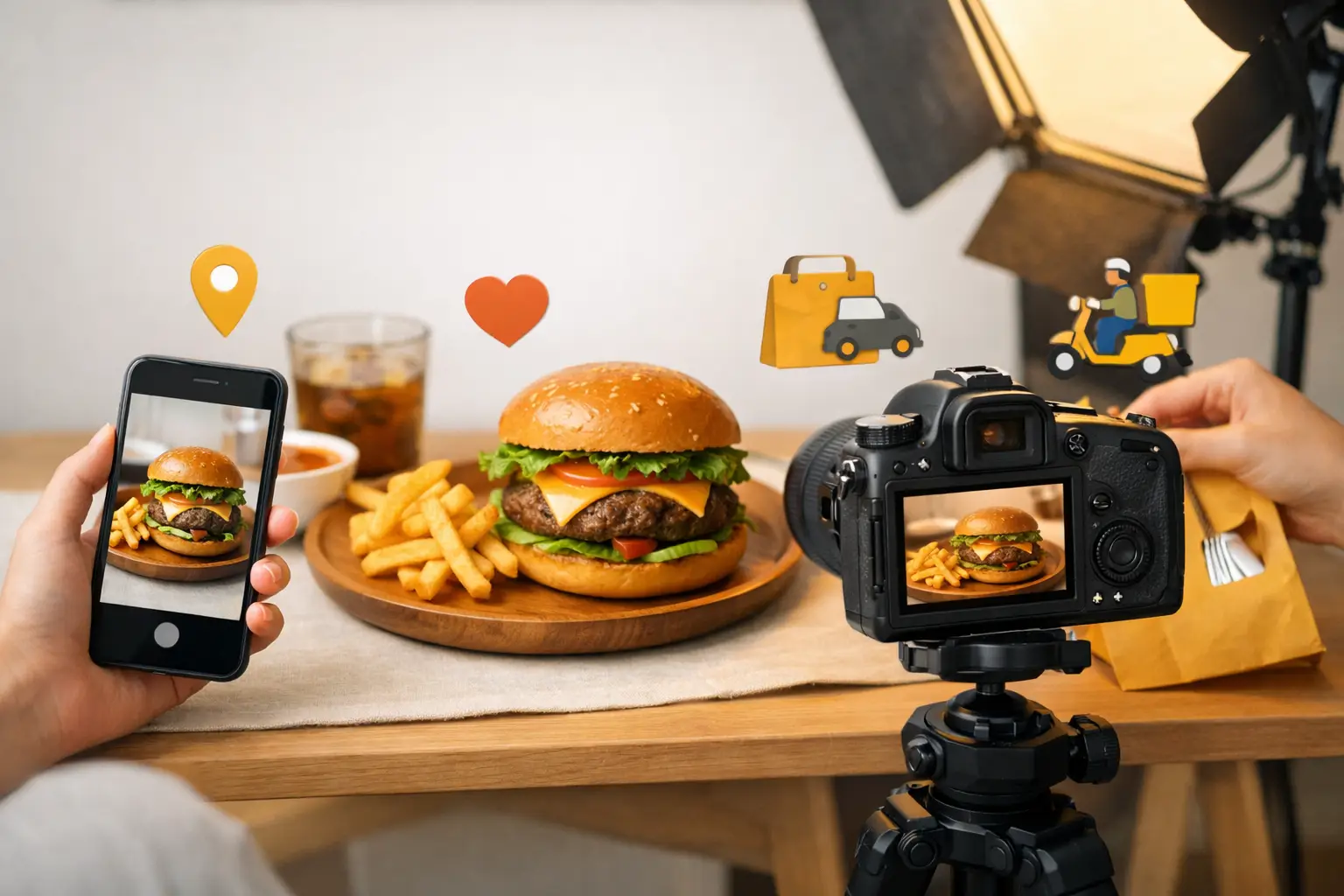
A lunch special has about two seconds to earn attention in a crowded feed. A delivery-app thumbnail has even less. Restaurant promo visuals are not decoration around the offer - they are the proof that the offer is worth ordering.
For restaurant teams, the challenge is rarely finding a promotion. It is producing enough polished creative to support it across social posts, paid ads, menu screens, email, delivery platforms, and in-store displays. The restaurants that move quickly do not treat every asset as a separate photo shoot. They build a repeatable visual production system around the food, the channel, and the campaign goal.
What Restaurant Promo Visuals Need to Do
A strong food image can create appetite. A strong promotional visual has a more specific job: make the viewer understand what is available, why it matters now, and what to do next.
That changes the creative brief. A glossy hero shot may work for a new menu launch, while a limited-time offer needs a clear product focus and room for price or promotional copy. A delivery-platform image needs instant recognition at a small size. A social story or short video needs movement early enough to stop the scroll.
The best assets combine three things: an appetizing product presentation, a clear promotional message, and a format built for the placement. If one of those is missing, performance suffers. Beautiful photography with no usable space for text can be difficult to turn into an ad. A discount graphic with an unappealing meal image can make the offer feel less valuable.
Start With the Offer, Not the Background
Before generating or designing anything, define the campaign in one sentence. For example: “Drive weekday lunch orders with a $12 bowl and drink bundle,” or “Build awareness for a new spicy chicken sandwich.” This keeps creative decisions connected to a commercial outcome.
Then identify the food item that should carry the frame. Promotions are more effective when the visual centers on one obvious decision. A crowded spread can work for catering or family meals, but it often weakens a single-item launch. Let the featured dish lead, then use sides, ingredients, or props to add context without competing for attention.
Build a Production System for Restaurant Promo Visuals
Restaurants often lose time because every campaign starts from scratch. The faster approach is to establish a visual system that can be reused, adjusted, and scaled as promotions change.
Create a Practical Visual Brief
A useful brief does not need to be long. It should answer what is being promoted, who it is for, where it will appear, and what feeling the image should create. Include the dish name, ingredients that must be accurate, preferred servingware, brand colors, and any visual elements to avoid.
For a fast-casual brand, the direction might be bright, close, energetic, and ingredient-forward. For a premium steakhouse, it may be darker, more restrained, and focused on texture. The goal is not to apply one food aesthetic everywhere. It is to make each campaign recognizable as your brand before the logo appears.
Be precise about food details that matter to customers. If your burger comes with a potato bun, do not use a generic brioche-style bun. If the menu item includes three tacos, show three tacos. AI-assisted production can move fast, but commercial accuracy still requires a review process.
Produce Variations Before You Need Them
One hero image is not a campaign library. Plan for multiple crops, compositions, and formats from the beginning. A vertical image may be best for stories and short-form video, while a square crop can support paid social. Landscape formats remain useful for web banners, email headers, and digital menu boards.
The most efficient workflow creates variations around the same visual direction: a close-up texture shot, a plated hero shot with negative space for copy, a lifestyle composition, and a motion-ready scene. This gives marketers options without creating a mismatched collection of assets.
With a food-specific platform such as Umami AI, teams can generate and iterate on these variations without booking a studio, sourcing props, or waiting for post-production. That is especially useful for recurring promotions, regional tests, ghost kitchen concepts, and menu items that need campaign support before a traditional shoot can be scheduled.
Match the Visual to the Channel
A visual should not simply be resized for every placement. Each channel has different viewing behavior, copy needs, and constraints.
For delivery apps and online ordering pages, clarity wins. Use a clean composition, a recognizable serving size, and enough lighting to show texture. Avoid heavy text overlays when the platform already displays the item name and price. The food should look like the thing customers expect to receive, not an abstract editorial image.
For paid social, build room for the message. The offer, deadline, or call to action should not cover the best part of the dish. Test a product-led version against a promotion-led version. In some cases, a close-up of melted cheese or a crisp fry performs better than a full plate because it creates an immediate sensory response. In others, especially value bundles, showing quantity is essential.
For organic social, use visuals with a reason to pause. Steam, sauce pours, ingredient movement, a final garnish, or a quick reveal can turn a static menu item into a short-form asset. Motion should add appetite or product understanding, not exist just because video is available.
For email and loyalty offers, put the promotion in context. A single hero visual paired with concise copy can work better than several competing images. The customer should be able to scan the offer, see the food, and act without deciphering the layout.
Use Consistency Without Making Every Campaign Look the Same
Consistency does not mean repeating the same overhead shot until the audience stops noticing. It means building recognizable choices around color, lighting, composition, props, and food styling.
Set a few guardrails: your preferred background range, whether food is shown tightly cropped or with more table context, how saturated colors should be, and how much graphic text belongs on an asset. These standards help a social manager, agency partner, or independent operator produce work that feels connected.
Then give campaigns room to change. A summer beverage launch can be brighter and more playful than a winter comfort-food promotion. A late-night offer may use stronger contrast and a more energetic composition. The underlying brand system stays intact while the creative responds to the moment.
Measure the Asset, Not Just the Campaign
Restaurants frequently evaluate the offer but ignore the creative choices that helped or hurt it. Track which image or video variation was used, where it ran, and what happened next. For paid placements, compare click-through rate, cost per order, and conversion rate. For organic content, watch saves, shares, profile visits, and comments alongside reach.
Do not assume the highest-engagement asset creates the most revenue. A dramatic food video may earn views, while a simpler bundle image may produce more orders. The right metric depends on the campaign objective.
Keep a record of patterns. You may find that tight close-ups work for new-item awareness, while full-table compositions work for group-order promotions. You may learn that your audience responds better to visible ingredients than stylized props. Those insights make the next creative brief faster and more reliable.
Avoid the Common Production Bottlenecks
The biggest bottleneck is often approval, not creation. Establish who checks food accuracy, brand fit, pricing, legal language, and final channel formatting. When everyone reviews every detail at the last minute, even a fast visual workflow becomes slow.
Another common issue is producing visuals that are attractive but operationally unusable. If a campaign needs a headline, disclaimer, and order button, request negative space in the composition. If the image will be cropped into multiple placements, keep key food elements away from the edges. If a promotion changes often, create a flexible visual template rather than rebuilding the asset every week.
Finally, do not over-polish a test. When an offer is being validated, speed and consistency can be more valuable than a large production budget. Save the most elaborate work for proven launches, flagship menu items, and brand moments where the investment has a clear role.
The restaurants that keep their marketing active are not necessarily creating more promotions. They are building a faster way to turn each promotion into food visuals that look credible, stay on-brand, and give customers a reason to order now.