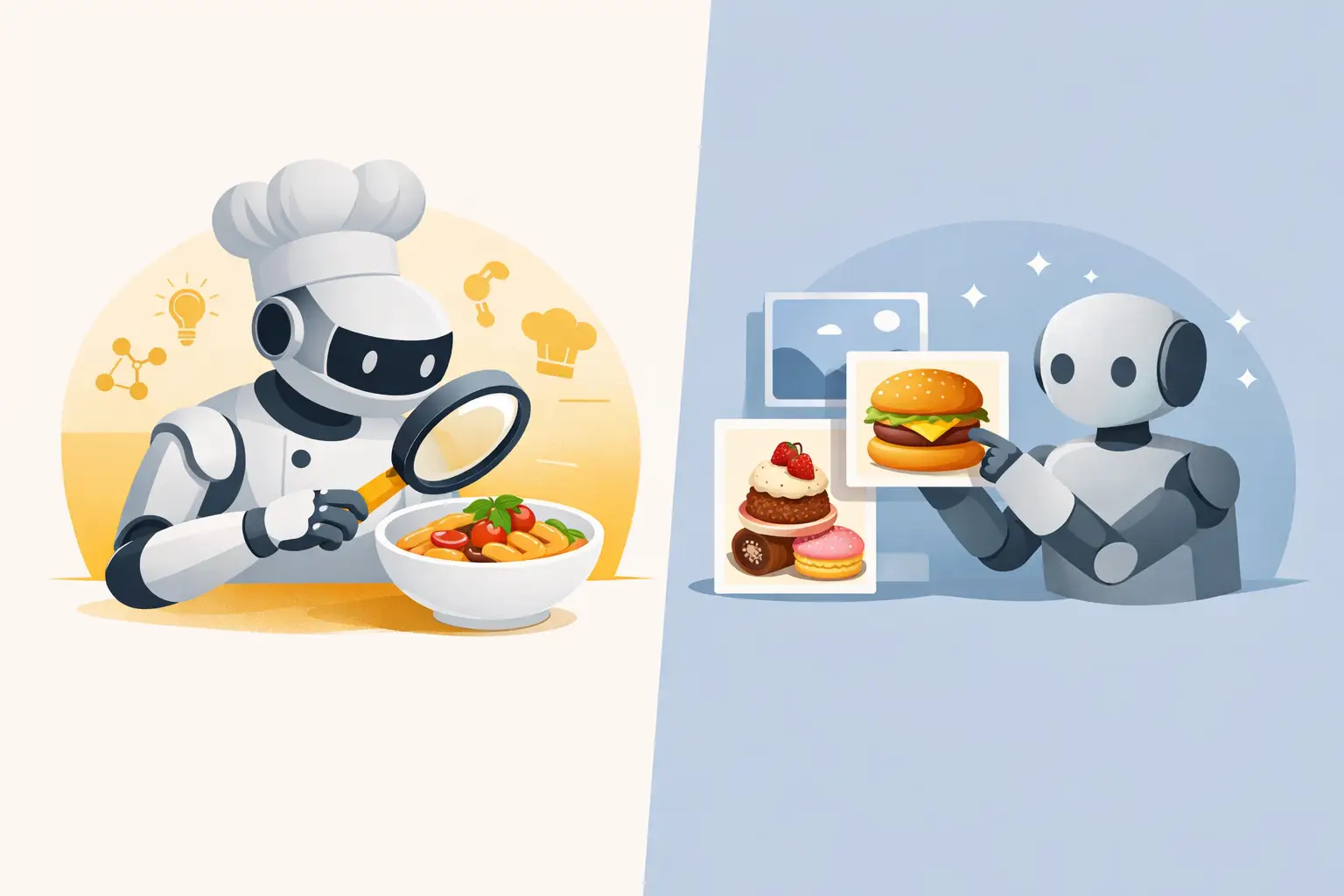
A burger ad fails for the smallest reasons. The cheese looks plastic. The lettuce sits wrong. The bun texture reads more like foam than bread. That is where specialized food AI vs generic generators stops being a theoretical comparison and becomes a production decision.
If you need food visuals for menus, paid social, delivery apps, product pages, promos, or seasonal campaigns, output quality is only part of the equation. Speed matters. Consistency matters. The number of usable assets per session matters. Most of all, the tool has to produce food that looks commercially appetizing without forcing your team into endless prompt cleanup.
Where specialized food AI vs generic generators really diverge
Generic image generators are built for range. They aim to handle everything from architecture to fashion to fantasy scenes. That breadth is useful, but it also creates friction when your workflow is narrow and commercial. Food is one of the most detail-sensitive categories in visual content. Small errors are easy to spot, and those errors make the result unusable fast.
A specialized food AI is tuned around one visual job: making food look believable, craveable, and campaign-ready. That changes the experience in practical ways. Instead of spending half your time trying to teach a broad model what melted cheese should do, what steam should look like, or how sauce should sit on a sandwich, you start closer to the result you actually need.
For a restaurant group or CPG team producing assets every week, that difference compounds. A generic tool may be able to create a strong image eventually. A specialized platform is built to get there with fewer iterations and less manual correction.
Generic generators are flexible, but food exposes their limits
Generic tools are attractive because they appear to do everything. For teams with mixed creative needs, that can sound efficient. One tool, many use cases, broad experimentation. If your team creates occasional food content and can tolerate some trial and error, a general model may cover enough ground.
The issue is that food content rarely rewards approximation. A drink splash that looks physically off can weaken an ad. A pizza with uneven topping logic can make a menu creative look synthetic. A dessert with the wrong surface texture can make the product feel low quality, even if the design layout is strong.
This is where generic generators often create hidden costs. The software may be cheaper or already available in your stack, but your team pays elsewhere. More prompt retries. More cherry-picking. More retouching. More time spent filtering out images that are visually interesting but not commercially usable.
That trade-off matters if your content pipeline is tied to launch dates, franchise support, agency deliverables, or weekly promotional calendars.
Food visuals are less forgiving than other categories
Many subjects can survive stylization. Food usually cannot, at least not if the goal is broad commercial use. Consumers know what fries, frosting, citrus flesh, grill marks, and condensation should look like. They react quickly when those signals are off.
That means a food-first AI system has a narrower but more valuable target. It does not need to be everything for everyone. It needs to generate assets that hold up in real business contexts, where credibility, appetite appeal, and speed to approval matter more than novelty.
What a specialized food AI does better
The biggest advantage is not that it creates food images and video at all. Generic tools can do that. The advantage is that the workflow is structured around food production logic.
That usually shows up in three places. First, composition trends more commercial. You get outputs that feel closer to ad creative, menu tiles, hero shots, product spotlights, or social promos rather than broad artistic interpretations. Second, the model behavior is more predictable around ingredients, plating, texture, lighting, and close-up presentation. Third, the platform tends to align better with repeatable asset generation, which matters when a team needs volume instead of one standout image.
For marketers and operators, this is not a minor distinction. A specialized platform reduces the gap between generated output and deployable output. That is the metric that affects production efficiency.
If you need ten visuals for a limited-time offer launch, the question is not whether a model can produce one good-looking burger. The question is whether it can produce ten on-brand variations that feel usable across web, app, email, paid social, and in-store digital screens.
The business case is operational, not just visual
A lot of AI comparison content stays at the level of aesthetics. That misses the real purchase decision. Most food businesses are not buying a creative toy. They are buying a faster content pipeline.
Specialized food AI supports that pipeline because it is closer to the needs of commercial teams. You are not just generating images. You are reducing the need for recurring shoots, cutting turnaround time for campaign variants, and creating more flexibility when offers change late.
That matters for restaurant owners managing multiple promotions, agencies serving several food clients, and e-commerce teams refreshing product imagery on tight timelines. When the tool is built around a single category, teams spend less time adapting the platform and more time shipping assets.
A specialized system also tends to fit usage-based production better. If your business works in credits, tiers, and campaign volume, it becomes easier to forecast how many assets you can create each month and when you need to scale up. That is more useful than broad creativity if your main concern is predictable output.
When generic generators still make sense
This is not a simple case of one category winning every time. Generic generators still have value.
If your team needs one platform for food, packaging mockups, event graphics, lifestyle scenes, abstract brand art, and internal concepting, a general model may be the practical choice. The same applies if food is a small part of your workload or if your designers already have a retouching process that can fix weak outputs efficiently.
Generic tools also make sense earlier in ideation. If you are exploring campaign directions and do not need final-quality food realism yet, broad models can help your team move quickly across concepts.
The limitation shows up when those concept images need to become production assets. That is usually the point where specialized food AI starts paying for itself.
How to evaluate specialized food AI vs generic generators for your team
The cleanest test is not feature count. It is usable output per hour.
Take a real campaign brief. Use the same creative goal in both systems. Measure how many assets look ready for actual commercial deployment, how many rounds it takes to get there, and how much editing your team still needs after generation. Do that across a few common use cases, such as a hero menu item, a product lineup, a promo graphic background, and a short-form animated visual.
Then look at consistency. Can the system maintain a recognizable visual standard across multiple outputs? Can your team generate enough variation without losing appetite appeal? Can non-designers use it without creating review bottlenecks?
These are the questions that matter more than raw image novelty.
The right tool depends on volume, speed, and approval standards
If your team publishes occasionally and has time to experiment, generic tools may be good enough. If your business depends on a steady flow of food assets, enough is usually not enough.
High-volume food marketing needs repeatability. It needs fewer misses, faster approvals, and outputs that fit professional channels without excessive fixing. That is where a specialized platform earns its position.
This is also why vertical AI tends to outperform broad tools in real production environments. Narrow focus is not a weakness when the category is complex and commercially demanding. It is often the reason the product works better.
A sharper tool for a narrower job
Specialized food AI vs generic generators is really a question about production fit. Do you want a broad creative engine that can attempt food, or a food-first system built to produce marketable visuals at speed?
For businesses that sell food, market food, or manage food brands, the answer often comes down to efficiency. Better outputs with fewer retries can save more time than a broad feature set ever will. That is why platforms like Umami AI are built around a narrower promise: more usable food visuals, faster.
The smartest choice is usually the one that removes the most friction between idea and launch.