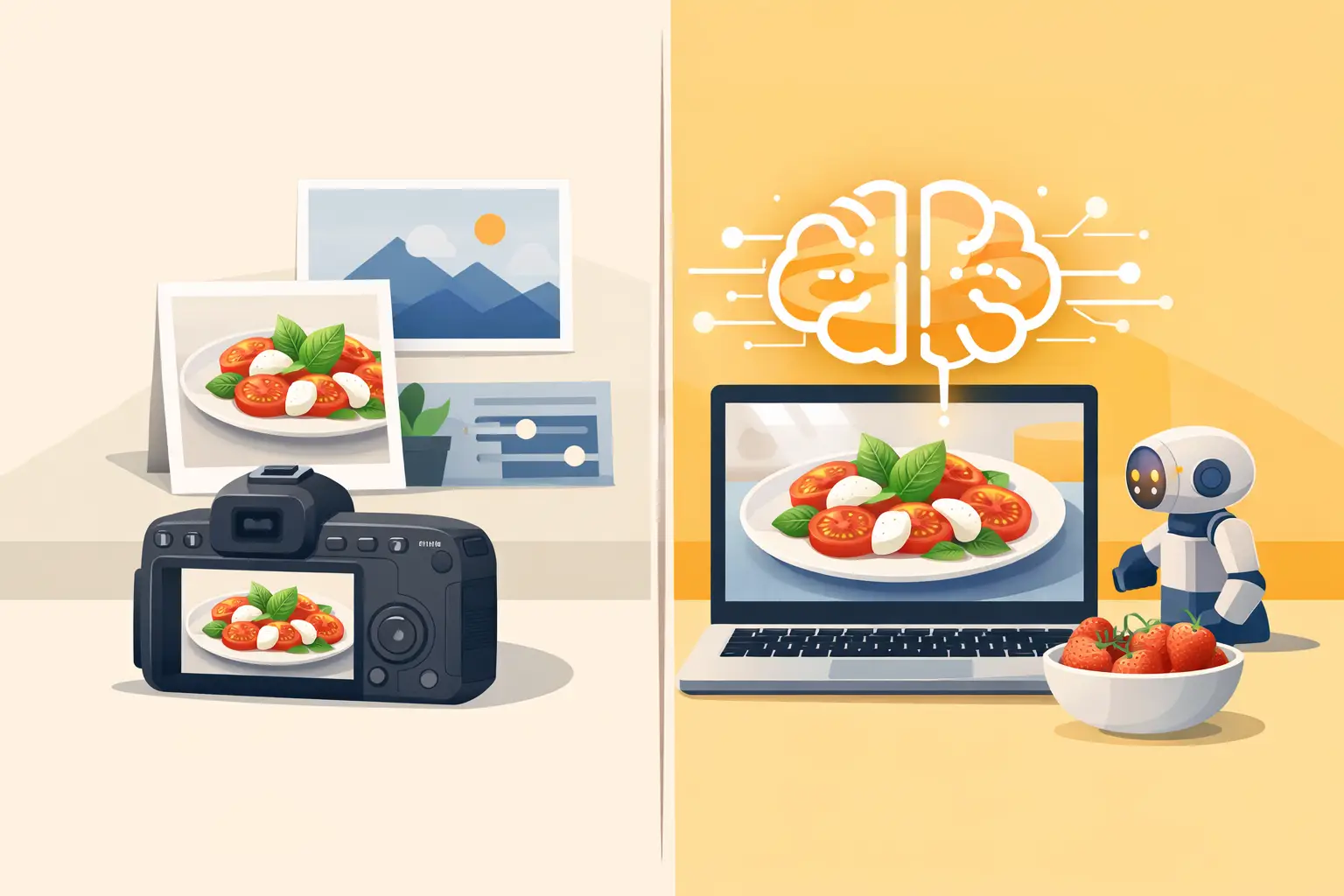
A seasonal menu launch can need 30 visual variations before the first customer places an order: a hero image for the website, vertical social posts, delivery-app banners, email headers, paid ads, and localized offers. That production requirement is where stock photos vs AI visuals becomes a real operating decision, not a design preference.
For food businesses, the best option depends on what must stay fixed, how often the content changes, and whether the image needs to represent an actual product. Stock photography still has a role. AI visuals give teams far more room to create, iterate, and scale. The practical move is to use each format where it performs best.
Stock Photos vs AI Visuals: The Core Difference
Stock photos are pre-existing, licensed images. You search a library, select an asset, purchase or download it under the applicable license, and adapt it for your campaign. The core advantage is predictability: you can inspect the exact image before use, and professional libraries often provide clear licensing terms and release information.
AI visuals are generated to a brief. Rather than searching for a photo that is close to the idea, a team can specify the dish, ingredients, plating style, camera angle, lighting, background, color palette, and format. This changes the workflow from asset selection to asset creation.
That distinction matters most in food marketing. A generic stock photo of a burger may look polished, but it may not match your recipe, brand colors, packaging, serving style, or audience. An AI-generated visual can be built around those details, then adjusted as the campaign evolves.
Neither route is automatically better. If you need an editorial-feeling image of a recognizable real location, a particular chef, or a real product in its final packaging, a licensed photograph or custom shoot may be the safer fit. If you need a steady volume of concept-driven, appetizing food assets, AI is usually the more flexible production system.
Where Stock Photography Works Well
Stock photos are useful when speed means finding something usable immediately, not creating something new. A small restaurant preparing a one-time blog post, for example, may only need a broad image of fresh herbs or a coffee shop scene. In those cases, searching a library can be efficient.
Stock also works when the image is intentionally general. Background textures, tabletop scenes, lifestyle moments, and ingredients can support a layout without needing to represent the exact menu item. Teams with limited design resources may appreciate the familiar process: choose, license, crop, and publish.
The constraints show up when specificity matters. Stock libraries contain a finite set of compositions, which means brands often settle for near-matches. The same popular assets can also appear across competitors' ads, websites, and social feeds. For a food brand that needs a distinct visual system, that sameness can weaken recognition.
Licensing deserves attention as well. A standard stock license may cover many commercial uses, but teams should review restrictions on print runs, resale, templates, sensitive uses, and other applications. The fact that an image is available to download does not mean it is cleared for every use case.
Where AI Visuals Create More Value
AI visuals are built for content programs that need volume without repeating the same composition. A restaurant group can create a campaign around a single menu item, then generate versions for lunch, late-night delivery, seasonal promotions, and different social formats. A beverage brand can test clean studio scenes, high-energy splash concepts, and editorial tabletop shots before committing media spend.
The value is not only faster image creation. It is faster iteration. A marketer can request a brighter background, tighter crop, extra negative space for copy, a different camera perspective, or a more premium visual direction without rescheduling a shoot or reopening a search library.
For food, control over composition is especially useful. The image can be structured around a plated dish in a specific bowl, a particular ingredient story, or a campaign color. It can also be generated in dimensions that match the placement, reducing the compromise that comes with forcing a horizontal stock image into a vertical ad.
This does not mean every generated asset is ready on the first attempt. Food visuals need review. Garnishes, utensils, textures, portions, and ingredient relationships can look wrong if the prompt is vague or the output is accepted too quickly. The best results come from a repeatable workflow: set a clear visual brief, generate options, select the strongest direction, refine details, and apply brand copy in the final layout.
Cost Is More Than the Asset Price
A stock image may have a low upfront price, especially for a single use. But asset cost is only one line item. Teams also spend time searching, checking licenses, adapting visuals, and sourcing alternatives when the first image does not fit. If a campaign needs dozens of unique images every month, those small delays add up.
Custom photography has a different cost structure: photographer fees, food styling, props, studio time, product preparation, revisions, and scheduling. It remains valuable for hero assets and exact product representation, but it is difficult to use as the default answer for every daily post, promotion, or test.
AI visual production can make the economics more predictable for recurring content. With a credit-based platform, teams can plan output against campaign needs and generate multiple directions before choosing one. That is particularly useful for agencies managing several food accounts, e-commerce teams refreshing product pages, and social managers who need fresh creative every week.
The right comparison is not “one stock photo versus one AI image.” Compare the total effort required to deliver a month of on-brand assets in the correct formats.
Brand Control and Authenticity
The strongest argument for stock photography is often authenticity. A photo of your actual dish, storefront, team, or packaged product proves what customers can expect. For menu listings and product detail pages, accuracy matters. Do not use a generated image that implies a meal includes ingredients, portions, or presentation customers will not receive.
AI is more effective when the visual is illustrative, promotional, or conceptual. It can create appetite appeal around a flavor, occasion, or campaign message while leaving real product photography to the places where literal representation is essential.
Brand control is where AI can outperform stock. Instead of accepting another brand's lighting, props, and styling choices, you can establish a repeatable look. Define your preferred mood, color direction, surfaces, lens feel, framing, and amount of text space. Over time, those decisions make content feel like a system rather than a collection of unrelated images.
A Practical Decision Framework
Use stock photography when the content is broad, low-volume, and does not need a proprietary look. Use custom photography when customers need to see the exact product, people, or location. Use AI visuals when the brief is specific, the content calendar is active, and the team needs multiple campaign-ready variations.
Before choosing a production path, ask four operational questions:
- Does this image need to show the exact product a customer will receive?
- Will we need more than one format, setting, or message variation?
- Can a library image match our visual direction without major compromise?
- Do we have a repeatable review process for quality, accuracy, and brand fit?
Those answers often point to a hybrid model. Capture real products for menus, packaging, and conversion-critical pages. Use AI-generated food visuals to support promotions, social content, concept testing, seasonal launches, and high-volume creative production. Keep a stock library available for occasional supporting imagery.
Build a Faster Food Content Workflow
The biggest advantage of AI is lost when every prompt starts from zero. Create a simple internal brief for each campaign: product or cuisine, audience, channel, mood, palette, composition, and any non-negotiable details. Save approved prompt patterns and composition directions so your team can produce consistently instead of rediscovering the style every time.
Then review outputs with commercial discipline. Check that food looks plausible, props support the brand, text has enough room, and the visual does not make claims your product cannot support. If labels, logos, or packaging must be exact, add those in a controlled design step or use real photography for that component.
A specialized platform such as Umami AI makes this workflow more practical by focusing generation and composition around food content rather than treating a plated dish like a generic image prompt. The result is a production process designed for the assets food businesses actually need.
Treat visual production like a content operation, not a once-a-quarter photo shoot. When every campaign has a clear role for stock, real photography, and AI, your team can publish faster while keeping the food, the offer, and the brand recognizable.